
Tools That Make a Solo Real Estate Investor Look Like a Big Company
What if a solo investor could deliver the steady, polished follow-up people expect from an established firm without building a large team? The right tools to make a solo investor look like a big company aren’t about creating an illusion. They help you keep leads moving while you handle everything else.
When one person manages prospecting, calls, texts, email, and deal work, even good intentions can turn into missed follow-ups and scattered conversations. Adding more software isn’t automatically the answer. Disconnected tools can create extra data entry and more places to check.
This guide compares practical options for building a lean, professional investor operation, from contact management and communication tools to AI-assisted lead qualification and appointment booking. You’ll learn how to assess an all-in-one platform against a custom stack, map the work your tools need to support, and avoid adding software without a clear purpose. The goal is to respond consistently across channels, give prospects a dependable experience, and stay transparent about who runs your business.
Key Takeaways
- Choose tools to make a solo investor look like a big company by focusing on organized follow-up and clear communication, not an image of having a large staff.
- Match each tool to a specific job, from capturing leads and managing contacts to scheduling appointments and handling administration.
- Compare options by task coverage, ease of use, integration, visibility, and room to grow before adding another platform.
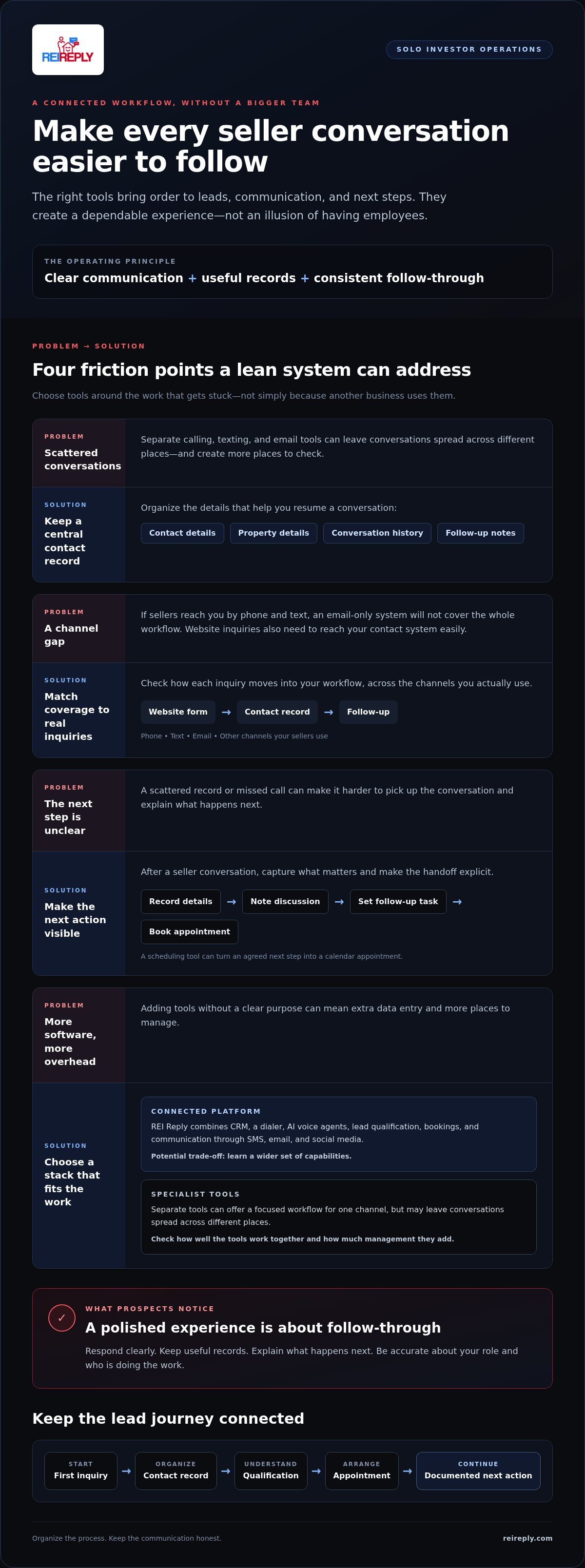
- Map your lead journey from first inquiry to contact record, qualification, appointment, and documented next action to find where work gets stuck.
- REI Reply brings CRM, a dialer, AI voice agents, lead qualification, bookings, and communication across SMS, email, and social media into a connected contact center.
Tools to Make a Solo Real Estate Investor Look Like a Big Company
One person can be the entire operation: answering inquiries, speaking with sellers, qualifying potential deals, booking appointments, and handling business administration. The challenge isn’t being small. It’s keeping follow-ups, contact details, and next steps organized across calls, texts, email, and other channels. The right systems bring order to that workload without requiring you to pretend you have employees.
A professional solo operation communicates clearly, keeps useful records, and follows through consistently while staying honest about who is doing the work. That’s the standard to aim for. Tools to make a solo investor look like a big company should create a dependable experience, not a false impression of company size.
Technology can standardize how an inquiry is captured, what information gets recorded, and how the next step is tracked. For example, when a seller reaches out by text, add the contact and property details to your central record, note what you discussed, and set a follow-up task. That makes it easier to resume the conversation later without searching through message threads or relying on memory. You’re still responsible for the relationship; the process gives it structure.
What prospects notice before they know your team size
Prospects experience your operation through the details: whether you respond, whether your messages are clear, and whether you explain what happens next. A missed call or scattered record can make follow-up harder and leave a conversation feeling disorganized. One gap doesn’t automatically undermine trust, but repeated gaps can create uncertainty.
Professional presentation means dependable communication, not implying that you employ a team. Use accurate language about your role, set clear expectations, and make each interaction easy to follow. A consistent process can feel polished while remaining transparent.
Why real estate investors need a different tool stack
Investor workflows revolve around property acquisition and conversations with potential sellers. You may need to capture an inquiry, organize property and contact details, qualify a lead, and arrange an appointment. Those steps differ from a generic startup’s focus on fundraising, market research, or investor updates. Broad business advice can help with planning, but it may not address the daily work of keeping seller conversations moving.
Real estate investing covers varied strategies and considerations, so your systems should fit how you source and evaluate opportunities. Start by identifying where your workflow breaks down: new inquiries, lead qualification, appointment booking, or recording the next action. Then choose tools around that bottleneck instead of adding software simply because another business uses it.
For investors focused on wholesaling, the same principle applies: connect automation to actual acquisition and follow-up tasks. The guide to automating a wholesale real estate business explores ways to organize those workflows. The goal is to make every interaction easier to manage while presenting your business honestly as it operates today.
The Essential Tools Behind a Polished Solo Investor Operation
A solo investor’s stack should move an inquiry from first contact to a clear next step, then keep business records organized. That takes more than a generic task app. Lead capture, seller communication, qualification, scheduling, and administration all need a place in the workflow. The tools to make a solo investor look like a big company can be one connected platform or a carefully chosen set of specialist tools. The right choice depends on where your process needs support and how much time you can spend managing software.
Front-office tools for leads and seller communication
Front-office tools manage conversations that can turn into property opportunities. A CRM or contact manager stores names, property details, conversation history, and follow-up notes. It provides a central record, but only if you enter information consistently and keep it current. Lead-capture tools collect inquiries from channels such as a website form; check how easily those details reach your contact system.
- Dialers and messaging tools support calls, texts, and email. Separate tools may offer a focused workflow for one channel, but can leave conversations spread across different places.
- AI contact-center systems can bring contact management and multiple communication channels into a shared workflow. REI Reply combines CRM, a dialer, AI voice agents, lead qualification, bookings, and communication through SMS, email, and social media. A broader platform may reduce tool switching, but you’ll need to learn its wider set of capabilities.
- Scheduling tools turn an agreed next step into a calendar appointment. They make the handoff from conversation to meeting explicit, though a separate scheduler can add another place to manage.
Channel coverage matters. If sellers reach you by phone and text, an email-only system won’t cover the full workflow. Proptech innovations in real estate show how digital platforms can support connected operations. For a solo investor, the practical test is whether the tools fit the way you actually handle acquisition leads.
Back-office tools that keep the business organized
Back-office tools help keep business activity orderly after a prospect conversation. Document storage keeps property files and correspondence together. E-signature tools support signing workflows. Bookkeeping software organizes income and expenses, while reporting tools help review activity and pipeline status. These systems support administration, not legal, accounting, or brokerage advice. Separate subscriptions can also mean separate logins and records.
A simple website gives prospects a place to understand your business and submit an inquiry. Consistent email signatures, business contact details, and message templates reinforce that presentation. The trade-off is upkeep: keep the website and templates accurate and current. An all-in-one platform can consolidate contact and communication tasks; specialist tools can offer more focused functions. Neither approach suits everyone. Keep the parts that solve real bottlenecks, and avoid entering the same contact details in several systems. Investors looking to centralize lead conversations can explore REI Reply’s investor contact-center platform.
How to Compare Investor Tools Without Building an Overcomplicated Stack
More features don’t automatically make a better operation. Identify the work that currently causes friction, then compare tools against that need. The right system should make your priority workflows easier to manage, not add another dashboard to check.
Decision rule: Choose the simplest stack that reliably covers your priority workflows. Automation can help you apply the same steps to each inquiry, record conversations, and track next actions. It doesn’t require you to imply that you have a large staff. Be transparent about who runs the business and let the process demonstrate its professionalism.
A practical scorecard for choosing investor software
Before comparing feature lists, rank your current bottlenecks: capturing leads, finding conversation history, responding across channels, qualifying prospects, or tracking appointments. Then assess each option using the same criteria. A simple low-to-high score can help you compare systems against your actual workload rather than relying on marketing claims.
| Criterion | What to assess | Strong fit looks like |
|---|---|---|
| Task coverage | Does it handle the specific workflow causing friction? | It supports the tasks you need without unnecessary features. |
| Ease of use | Can you complete routine work without extra steps? | Contact updates and follow-ups fit naturally into your day. |
| Integration | Can information move between the tools you already use? | Key details don’t need to be re-entered repeatedly. |
| Visibility | Can you see contact details, history, and next actions? | You can quickly tell what happened and what needs attention. |
| Room to grow | Can the setup accommodate additional workflows later? | You can expand without replacing everything at once. |
Test the full journey before committing: enter a sample inquiry, add property and contact details, record a conversation, note qualification information, and schedule a follow-up. Check whether the contact record and history remain easy to find at each step. If a routine task means searching across several systems or copying the same details repeatedly, that’s a real integration cost, even when each tool looks capable on its own.
When separate tools or one platform makes more sense
Separate tools can suit investors who already have a dependable setup and need to fill one narrow gap, such as scheduling or document management. A unified platform may reduce handoffs when calls, texts, email, and social messages all form part of lead handling. Consolidation helps only when the platform fits your daily process and its capabilities serve a real need.
Watch for overlap. Multiple systems that store the same contacts or automate the same communication can create duplicate records and extra administration. Don’t choose software solely because its feature list looks impressive. The tools to make a solo investor look like a big company should create clear, repeatable workflows behind the scenes while your communication stays honest and personal. Start with the highest-priority task, assess the full journey, and add complexity only when a real need justifies it.
Build a Lean Real Estate Investor Tech Stack Step by Step
A useful tech stack isn’t the one with the most automation. It supports a real workflow without making you manage extra systems. Build in stages: identify the friction, choose a core system, connect only the tools that fill a gap, and review how the process works. Start with one high-friction workflow, not every task in your business.
Start with the point where prospects get stuck
Pinpoint the breakdown before shopping for software. Are calls going unanswered? Are replies delayed, follow-ups inconsistent, or contact records scattered? Use your recent activity to create a simple baseline: note the inquiries received, the ones recorded, and the follow-up actions completed. This is an operational snapshot, not a forecast of deals or conversions.
Set a goal you can control. For example, record each new inquiry in one place, capture its source and property details, and assign a clear next action. Tools to make a solo investor look like a big company should help you deliver that process consistently while remaining transparent about who is responsible for the business.
Connect the workflow and review it regularly
Map the path from initial inquiry to follow-up. A prospect contacts you, their details become a contact record, you qualify the inquiry, arrange an appointment when appropriate, and document the next action. At each handoff, preserve useful context: who contacted you, what property they asked about, what you discussed, and what needs to happen next. If a call leads to a text exchange, for instance, the available history should help you continue the conversation without relying on memory.
- Identify one bottleneck. Choose the problem that creates the most friction in your day-to-day process.
- Select the core system. Make it the main place to manage the workflow and relevant contact information.
- Connect supporting tools. Add only what the process needs, such as scheduling or a communication channel, and check that key details carry through.
- Review and refine. At a regular cadence that fits your workload, review missed inquiries, completed follow-ups, and appointment handling. Fix weak handoffs before expanding automation.
Keep the review practical: check whether inquiries are captured, whether the next action is clear, and whether appointments are handled as intended. If the workflow still requires repeated manual transfers, simplify or reconnect the tools before adding another layer. If calls are your main pressure point, an AI voice agent can support voice-led contact workflows; for broader follow-up, focus on how each inquiry moves across your chosen channels.
Ready to bring investor communications into one workflow? Explore REI Reply’s contact-center platform for tools that coordinate contact management, communication, qualification, and bookings.
How REI Reply Helps a Solo Investor Run a Connected Contact Center
A solo investor can use a connected system to coordinate seller conversations without juggling disconnected tools. REI Reply is an AI-powered contact center built for real estate investors. It brings contact management and communication workflows together to support the steps from initial contact through qualification and booking, while you remain in control of your business.
Match REI Reply capabilities to solo investor tasks
Consider a new seller inquiry moving through your workflow. CRM and contact-management capabilities help keep the prospect’s information and interaction history together. The dialer supports call workflows, while AI Lead Intelligence supports lead handling. AI agents handle inbound and outbound calls, texts, emails, and social interactions, bringing communication across channels into the contact-center workflow.
REI Reply also includes natural voice AI, voice cloning, automated actions, lead qualification, and booking capabilities. Together, these tools support a process in which a prospect’s conversation can lead to qualification and an appointment, with relevant contact context available for the next step. They don’t change who runs your operation; they provide infrastructure for managing contact activity more systematically.
For a closer look at how the platform is positioned and its features, read this REI Reply review and platform overview. If coordinating conversations across channels is the gap in your current setup, an investor-focused contact center can bring those tasks together.
Understand access, reported usage, and data handling
AI Contact Center technology is available only to members on the $99/mo plan or higher, with no exceptions. Qualifying members receive 100% free access to that technology while on the required plan.
REI Reply reports serving 35,000+ investors, closing 600+ deals per month, and delivering 4.5+ million SMS messages monthly. These company-reported usage figures describe platform activity; they are not promised results for an individual investor or a forecast of what your business will achieve.
Keep data handling in view when choosing a contact workflow. Platform usage data, including message content, phone numbers, call logs, and delivery status, may be transmitted to Twilio for processing in accordance with Twilio’s Privacy Policy. By using the platform, users acknowledge and agree to this processing. REI Reply states it does not sell or share this data beyond what is needed to provide the service. Review the applicable privacy information and make sure the tools you use fit your communication practices.
Ready to see how a connected contact center could fit your investor workflow? Explore REI Reply and its contact-management, AI, and multi-channel communication capabilities.
Make Your Next Workflow Upgrade Count
Your next move doesn’t need to be a full technology overhaul. Pick one point in your investor workflow that feels harder than it should, then define what a smoother process would look like. Maybe you need to know where a seller conversation stands, or make sure an agreed next step is recorded. Decide what needs to change before adding another tool.
That focus keeps your operation lean and gives you a clear way to judge whether a new system fits: does it support the workflow you chose without adding unnecessary complexity? The best tools to make a solo investor look like a big company help you deliver an organized, consistent experience while staying authentic about how your business operates.
When you’re ready to bring investor communications into a more connected workflow, explore REI Reply and build a more connected investor operation. Start with the process that needs the most attention, make a deliberate upgrade, and build from there. You can create a polished operation one practical improvement at a time.
Frequently Asked Questions
Can a solo real estate investor use AI without pretending to have a large team?
Yes. AI can support repeatable communication tasks without changing who operates your business. You can explain that you use automated tools to organize inquiries or assist with contact handling, rather than implying employees handled those interactions. The tools to make a solo investor look like a big company should support the work behind your business, not create a misleading story about its size.
What should a solo investor automate first?
Start with the task that creates the most friction in your operation. If inquiries arrive through several channels, first focus on making sure they’re captured and easy to review. Decide what should improve, such as having fewer unrecorded conversations, before selecting software. After introducing a tool, review your process records to see whether the task is easier to manage.
Will AI communication sound impersonal to motivated sellers?
It can if messages ignore what a seller has already shared or leave them unsure how to respond. Keep communication relevant to the conversation, use plain language, and make the next step clear. Review real interactions, including situations where a person may need to take over or add context. AI can support consistent contact, but your judgment still matters in sensitive or nuanced seller conversations.
Do I need a separate CRM if I use an AI contact center?
Not necessarily. REI Reply’s AI-powered contact center includes CRM and contact-management capabilities, so a separate CRM may duplicate functions you already have. Compare your existing records and workflows with the platform’s capabilities, then consider how information would move between systems. AI Contact Center access is limited to members on the $99/mo plan or higher, with no exceptions. Qualifying members receive 100% free access to that technology while on the required plan.
How can I evaluate whether an investor tool is worth keeping?
Set a practical goal tied to a task you perform regularly, then check whether the tool supports it without creating new steps. For example, see whether you can find a seller’s latest message and planned follow-up when you return to their record. Review actual usage and process quality over time. Keep tools that clarify work you do, and reconsider those that go unused or duplicate another system.
What happens to call and message data when I use an AI contact platform?
Review the platform’s privacy information to understand how usage data is handled. REI Reply states that data such as message content, phone numbers, call logs, and delivery status may be transmitted to Twilio for processing in accordance with Twilio’s Privacy Policy. By using the platform, users acknowledge and agree to this processing. REI Reply also states it doesn’t sell or share usage data beyond what’s needed to provide the service. Read the applicable privacy policies before using the platform.


