
Compare AI options for inbound real estate calls
AI voice agents are a direct option for AI for inbound call handling in real estate. They can answer property enquiries, capture lead details, and keep conversations moving while agents are busy or away. The right tool also needs to support follow-up, appointment booking, CRM integration, and a clear handoff to a person when needed.
A quick answer only helps if the enquiry reaches the right next step. Real estate teams need to know what AI can handle independently, when human support matters, and how each option fits their existing lead process.
This comparison covers the main approaches, from AI voice agents and contact center platforms to call routing and traditional answering services. Compare how each handles property questions, follow-up, appointment scheduling, CRM connections, and human handoffs to find a fit for your inbound call workflow.
Key Takeaways
- Compare AI answering tools by how they handle property questions, qualify enquiries, and route calls that need a person.
- Match the setup to your team: solo agents and brokerages may need different call coverage, workflows, and oversight.
- Map the lead journey from first call through follow-up and showing scheduling to spot where enquiries can stall.
- Assess CRM connections by whether call details and next steps flow into the records your team already uses.
- Use the decision guide to weigh around-the-clock coverage against the human handoffs your callers still need.
Inbound lead response and after-hours enquiry handling
Response speed and coverage shape what happens after a buyer calls about a listing. Compare options by how quickly they answer, qualify the enquiry, and route it to the next step.
Speed-to-Lead Response
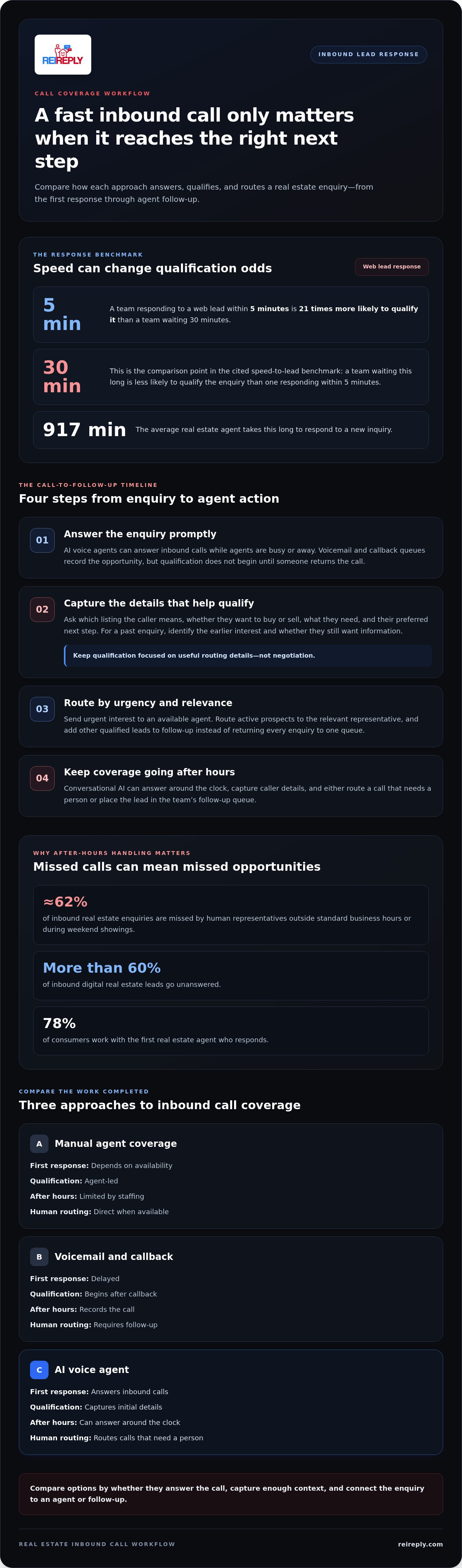
Speed-to-lead measures the gap between a new enquiry and the first response. A team responding to a web lead within 5 minutes is 21 times more likely to qualify it than a team waiting 30 minutes. The average real estate agent takes 917 minutes to respond to a new inquiry. AI voice agents can answer calls promptly, then collect basic details for an agent to act on.
Unlike a live response, voicemail and callback queues only record the opportunity; they don’t start a qualification conversation. Ask about the property, the caller’s intent, and their preferred next step. Route urgent interest to an available agent and add other qualified leads to follow-up.
Missed-Lead Reduction
Inbound coverage addresses calls that arrive during showings, meetings, negotiations, or office closures. Human representatives miss roughly 62% of inbound real estate enquiries outside standard business hours or during weekend showings. Conversational AI can operate around the clock, answering those calls and capturing details instead of leaving every caller to voicemail.
More than 60% of inbound digital real estate leads go unanswered, while 78% of consumers work with the first real estate agent who responds. These figures make after-hours coverage a practical comparison point for brokerages: can the system start a conversation, record the need, and send the lead to a person?
Focus qualification on useful routing details, not negotiation. Capture the listing, whether the caller wants to buy or sell, and when an agent should follow up. For a past enquiry, identify the earlier interest and ask whether the caller still wants information. Route active prospects to the relevant representative instead of returning every lead to one queue.
Compare three common approaches against the work they complete:
| Option | First response | Qualification | After-hours handling | Human routing |
|---|---|---|---|---|
| Manual agent coverage | Depends on availability | Agent-led | Limited by staffing | Direct when available |
| Voicemail and callback | Delayed | Begins after callback | Records the call | Requires follow-up |
| AI voice agent | Answers inbound calls | Captures initial details | Can answer around the clock | Routes calls needing a person |
Choose an option that covers missed calls and captures enough context for an agent to continue the conversation.
What Are AI Tools for Real Estate Agents?
AI tools handle different parts of real estate communication, from answering calls to practicing sales conversations. Compare their tasks, team fit, and ability to bring a person into the conversation.
AI answering tools include voice agents that respond to inbound calls, gather caller intent, and share approved listing information. Some can initiate a callback in under 2 seconds, while more complex questions may need a person.
AI and Human Receptionists
AI answering services handle routine conversations automatically, while human receptionists can respond with personal judgment during each call. In mature deployments, AI voice agents handle 70% of routine inbound calls without human intervention. That makes them suited to repeatable questions, such as whether a listing is available or how to request details.
For a solo agent, an AI service can cover calls while the agent is showing a property. A brokerage may need routing by listing, location, or assigned representative. Human answering services provide a person at the first interaction; AI can sort common requests and reserve staff time for prospects with specific needs.
Agent Support and Handoff
AI can collect caller intent and summarize the request before handoff. It can transfer an urgent call to an available agent or capture details for follow-up when nobody can answer. For after-hours enquiries, set rules for which requests trigger a transfer and which enter the team’s follow-up queue.
This approach supports agents rather than replacing them: the system handles routine communication, while people take on complex questions, negotiations, and decisions that need context. A useful handoff includes the caller’s name, the listing, their question, and the next action they expect.
Accurate property details depend on the information available to the AI and how it responds when something is unclear. Keep listing facts, such as availability and stated pricing, tied to an approved source. For fair housing questions, the system should avoid improvising and route the caller to a qualified human representative.
AI role-play tools serve a different purpose from answering services. Agents can practice conversations about buyer intent, objections, and appointment requests before speaking with prospects. Review practice exchanges for clear questions, accurate property information, and a natural transition to the next step.
Before choosing a service, ask what it can answer automatically, how it handles uncertain property details, which calls it transfers, and what information reaches the agent. Also ask how it supports your language needs and whether solo-agent or brokerage routing fits your team. For teams exploring AI voice agent workflows, these criteria clarify how automated calls can support real estate communication.
Property inquiry follow-up and showing scheduling
A property enquiry calls for a next-step decision: answer a question, continue follow-up, or arrange a showing. Compare tools by whether they capture the caller’s preferred timing, identify the listing, and move the request toward an agent or appointment.
Appointment asks are a useful measure of call quality. The cited benchmark compares agents who ask for an appointment on 15% of calls with top producers who ask on 45%. The example agent leaves 75% of opportunities on the table. Tracking appointment asks can help teams find where conversations fail to turn into a concrete next step.
Use a consistent script to capture the details needed for scheduling:
- Identify the property or listing the caller wants to see.
- Ask whether they prefer a showing or have a question first.
- Record preferred days and times, plus the best way to follow up.
- Send requests needing judgment or confirmation to the responsible agent.
For example, someone calling about a listing may want to view it after work. Capture the property, requested timing, and any question the agent must answer. A human representative can then confirm the visit and handle details that depend on the property or seller.
Scheduling depends on how the tool handles availability. A system connected to an accurate calendar can offer open appointment options. Without current availability, it should capture preferences for an agent to confirm. Compare what happens when a requested slot is unavailable, showing instructions need clarification, or the caller wants to discuss several properties.
Follow-up should reflect the caller’s intent, not repeat the same message to every prospect. Someone who requested a showing needs confirmation and relevant visit details. A person comparing listings may need property questions answered before scheduling. For a past enquiry, a brief check-in can establish whether the original property or search is still relevant.
Tracking appointment asks can increase appointment requests by 40-60%. Review calls by outcome: scheduled showing, requested callback, information needed, or no appointment interest. That breakdown helps a brokerage refine its script and spot where agents need clearer handoff notes.
Choose a workflow that captures the request, respects actual availability, and assigns confirmation to the right person. The goal is a clear path from enquiry to showing, not an appointment record without the details needed to complete it.
CRM integrations and human handoff workflows
AI call handling can misroute leads when records are incomplete, listing details are outdated, or transfers lack context. A reliable workflow connects each conversation to clear ownership, accurate information, and a defined human handoff.
Start with the CRM record. Capture the caller’s name, phone number, property of interest, stated intent, and requested next step. For example, an enquiry about a specific listing should create or update a record linked to that property. The representative can then see the conversation timeline instead of piecing together separate notes.
Set clear boundaries for calendar and MLS integrations. Calendar access can support appointment workflows when availability is current and correctly assigned. MLS data may inform listing answers, but define which fields the system can use and how updates reach it. Don’t let AI guess about availability, pricing, or property details when its source conflicts with a current record.
WhatsApp can add a communication channel for prospects who use it. If the platform supports WhatsApp, decide whether messages and calls share a CRM record, how staff see earlier exchanges, and who owns the reply. Keep channel preferences and handoff notes together so an agent can respond without asking the prospect to repeat the request.
Latency affects how natural a voice conversation feels. Sub-300 ms latency can feel natural, while latency above 800 ms can feel robotic. Interruptions matter too: callers may correct an address or change their appointment request mid-sentence. Test those moments with realistic examples, then confirm whether the system pauses, listens, and records the corrected detail.
A useful handoff carries the caller’s reason, relevant listing, details already captured, and action needed. Set routing rules for urgent requests, questions requiring an agent, and calls for follow-up. For example, a caller reporting an error in listing information should reach a person rather than receive a guessed answer.
- Map each call outcome to a CRM field and an owner.
- Define which calendar events the system can offer or record.
- Set the approved source for property details and updates.
- Test transfers, interruptions, and channel history using sample calls.
The main risks of AI call handling are incorrect or outdated information, lost context during interruptions, and incomplete CRM records. Clear knowledge sources and escalation rules reduce these risks, but negotiation and unusual property questions still require human judgment.
Compare platforms by the data they pass, the systems they connect, and what an agent sees after transfer. A useful integration preserves the conversation timeline and clarifies the next action, whether the enquiry came through WhatsApp, a listing call, or another channel.
24/7 Inbound call handling
Real estate enquiries don’t follow office hours. A buyer may call after viewing a listing online, while the team is closed or agents are showing properties. Conversational AI can answer inbound calls 24/7, including overnight and weekends, giving callers a live first interaction instead of a closed-office message.
The coverage gap is especially clear from 6 PM to 9 AM, when buyers browse Zillow most and human agents are off. A round-the-clock system can take the initial call, understand the caller’s purpose, and capture details for the team. That creates continuity between an evening enquiry and the next available agent.
Coverage alone isn’t the goal. Real estate teams need a defined path for routine questions, urgent requests, and leads that need a person. Before launch, decide which questions AI can answer from approved information, which calls should transfer, and what belongs in the follow-up record.
Use a simple workflow to keep 24/7 handling useful:
- Answer with a clear greeting and identify the property or reason for calling.
- Ask focused lead qualification questions about the caller’s intent and needs.
- Share approved listing information, then avoid guessing when details are unclear.
- Route urgent or complex enquiries to a person, or record a clear callback request.
- Pass the call summary and contact details to the responsible real estate team.
Volume changes how teams should configure coverage. A solo agent may need calls captured while meeting a client; a brokerage may need routing by listing, location, or assigned representative. For example, an enquiry about a property managed by one team should reach that team, not sit in a shared inbox without ownership.
Knowledge needs maintenance after launch. Assign someone to update listing facts, office information, and routing rules when they change. Current information helps AI respond within its role to questions about new listings or changed showing plans, and direct exceptions to a person.
Measure whether the system connects callers to the right next step. Review call records for answered enquiries, completed transfers, callback requests, and unresolved questions. Use those examples to refine the greeting, qualification prompts, and escalation rules, then review the workflow as call volume changes.
For a real estate team weighing continuous call coverage, explore inbound call handling options and map how each enquiry should move from first answer to agent follow-up.
REI Reply is an AI-powered marketing and contact center platform built for real estate investors managing inbound enquiries and follow-up. Its AI Contact Center and AI Voice Agents support conversations across calls, texts, email, and social media, helping qualify prospects and move promising leads toward booked deals. The AI Ads Platform adds lead generation to the wider workflow. Consider REI Reply when your current process leaves calls, messages, or follow-ups scattered across separate tools, and you want one AI-driven system supporting those interactions. The right fit depends on whether your priority is call handling, broader lead communication, or attracting prospects. Explore the REI Reply platform to see how it fits your lead workflow.
Build a Call Workflow That Moves With Your Team
Make call handling part of a clear operating rhythm. Decide which conversations AI should manage, where a person must step in, and how each enquiry reaches its next owner. Review call outcomes and refine the workflow as listings, staffing, and lead volume change.
For teams considering AI for inbound call handling in real estate, the strongest choice fits daily operations, not just a long feature list. Start where callers currently wait or information gets lost. Define a better handoff, then choose technology to support that need.
REI Reply offers tools for real estate lead communication and contact handling. If you’re ready to discuss how it could fit your workflow, contact REI Reply. Take the next step with a clearer plan for every call and a stronger path from enquiry to action.
Frequently Asked Questions
Can the AI handle multiple inquiries at the same time?
AI voice agents can handle inbound calls, but simultaneous conversations depend on the system’s configured capacity. A brokerage receiving calls about several listings should map expected peaks and decide how to handle overflow. Test what happens when multiple callers ask about different properties at once, including whether calls are queued, routed, or recorded for follow-up.
Is this solution secure and compliant?
REI Reply states that usage data, including message content, phone numbers, call logs, and delivery status, is transmitted to Twilio for processing. It also states that it doesn’t sell or share this data beyond what’s needed to provide the service. These details describe data handling, but don’t establish compliance with every brokerage’s obligations or practices.
What is the Best AI Calling Solution for Real Estate in 2026?
There’s no single best option for every team; the right fit depends on the calls to handle and the tools in use. Compare inbound coverage, lead qualification, appointment booking, CRM integration, and transfer workflows. For AI for inbound call handling in real estate, consider whether the system is designed for investors, agents, or both, and whether its workflow suits your callers.
How do AI phone agents handle property inquiries, lead qualification, and appointment scheduling?
AI phone agents can answer inbound calls, gather a caller’s stated needs, and use prompts to organize the enquiry. They can also support appointment booking. For example, a caller can explain their interest in a property and preferred next step while the system records details for follow-up. Define how the agent should handle questions requiring human judgment.
What are the best AI call answering services for real estate in the United States?
The right service depends on whether you need call answering alone or a broader lead communication system. Compare inbound enquiry handling, prospect qualification, appointment booking, contact management, and CRM integration. Real estate investors may value lead-generation and deal-booking tools, while a brokerage may prioritize routing and team ownership. Match the service to your workflow.
How much do AI inbound call handling services for real estate cost?
Costs vary by plan, included tools, and service scope. Compare features such as voice handling, contact management, CRM access, and additional communication channels. REI Reply offers a subscription plan with AI-powered marketing and contact center tools; compare the features your workflow needs, not just the headline price. Review plan details before choosing.
How can a real estate business set up an AI phone agent and connect it to a CRM?
Define the calls the agent should handle, the questions it can answer, and when a person must step in. Connect the CRM and map captured details to the right contact fields. Test a sample call from greeting through record creation, then confirm the assigned agent can see the caller’s request and required follow-up.
How do AI call systems protect caller data and comply with real estate privacy requirements?
Understand what caller information the system collects, where it is processed, and how it reaches your CRM. REI Reply states that Twilio processes usage data, including phone numbers, message content, call logs, and delivery status. Set internal access and retention practices for these records, and review how your data-handling procedures apply to calls and follow-up.


