
Automated prospect engagement for real estate investors through email
Follow-up shouldn’t depend on someone remembering every prospect and property detail. Automated prospect engagement for real estate investors uses email workflows, property updates, and AI-assisted communication to keep conversations relevant and moving, without relying on manual outreach alone.
That doesn’t mean sending everyone the same message. Prospects have different interests and timelines, and thoughtful automation can organize those signals, deliver timely updates, and support personalized follow-up. Generative AI can help draft and tailor communications, while people remain central to relationship-building and investment decisions.
This guide explains how real estate automation works in practice and how email campaigns can nurture prospects who aren’t ready to act. You’ll learn how property updates and generative AI fit into an engagement system, which repetitive tasks automation can ease, and why thoughtful timing and relevant content matter more than simply sending more messages.
Key Takeaways
- Map repetitive prospect tasks to automation so you can focus personal attention where it matters most.
- Build email updates around investor interests and property changes to keep follow-up relevant.
- Use generative AI to draft and adapt messages, then review them for accuracy and a human touch.
- Connect lead capture, follow-up, and nurturing in a clear workflow so prospects don’t slip through the gaps.
- Assess automation software by how well it supports your lead pipeline, communication needs, and daily operations.
Custom AI and automation solutions for real estate investors
A website inquiry, an email reply, and a property update can each trigger a different follow-up action. Custom automation connects these actions, helping investors organize opportunities and focus attention where it matters.
Comparing Lead Engagement Platforms
Lead engagement platforms differ in how they capture, organize, and follow up with prospects. Compare them against your workflow, not a feature count. A CRM centers on contact records and deal stages; marketing automation focuses on scheduled campaigns; a contact center coordinates conversations across channels. Check how each handles investor preferences, response history, and handoffs. These differences determine whether useful information reaches your team or stays siloed.
Automated Lead Capture and Follow-Up
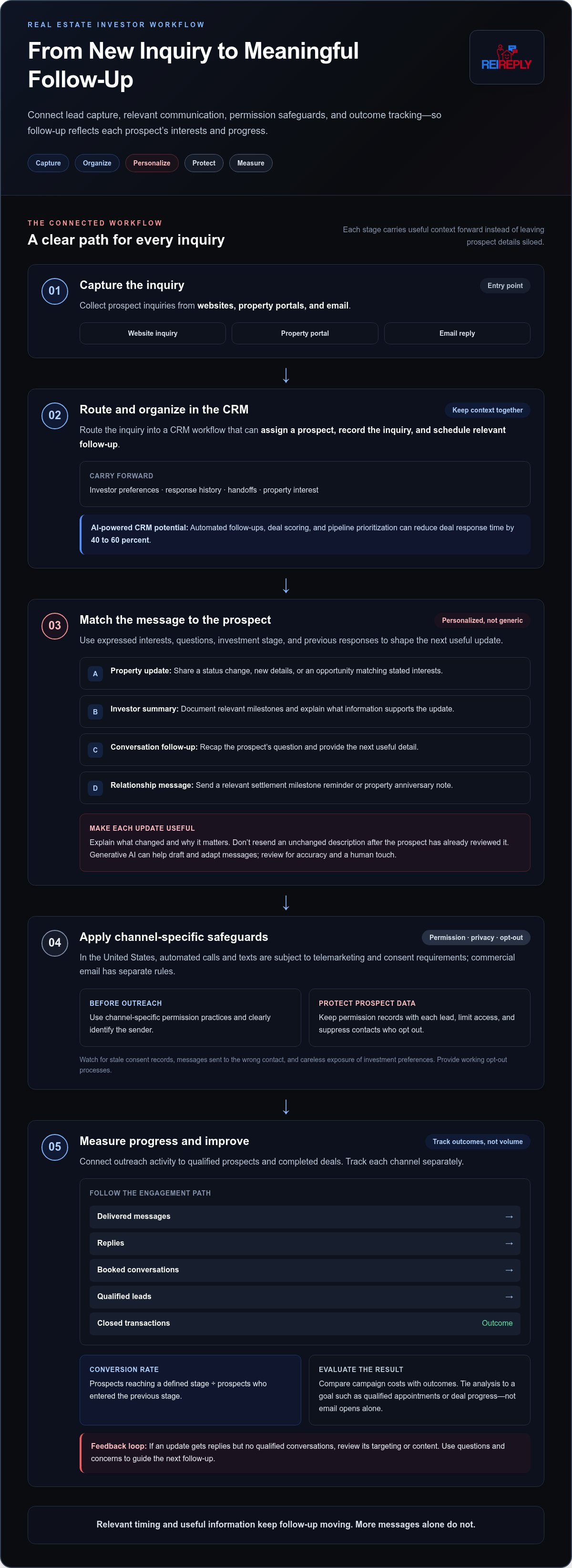
Lead capture software collects inquiries from sources such as websites, property portals, and email, then routes them into a CRM. From there, an automated workflow can assign a prospect, record the inquiry, and schedule relevant follow-up. For example, someone asking about a rental property could receive information tied to that interest. AI-powered CRMs can reduce deal response time by 40 to 60 percent through automated follow-ups, deal scoring, and pipeline prioritization.
Rules for Automated Prospect Outreach
In the United States, automated calls and texts are subject to telemarketing and consent requirements, while commercial email has separate rules. Use channel-specific permission practices, clearly identify the sender, and provide working opt-out processes. Privacy risks include relying on stale consent records, messaging the wrong contact, or exposing investment preferences through careless data handling. Keep permission records with each lead, limit access to prospect details, and suppress contacts who opt out.
Measuring Engagement ROI and Conversions
Measure engagement by connecting outreach activity to qualified prospects and completed deals. Track each channel separately, including delivered messages, replies, booked conversations, qualified leads, and closed transactions. For example, if a property update gets replies but no qualified conversations, review its targeting or content. Calculate conversion rates by dividing the prospects who reach a defined stage by those who entered the previous stage. Compare campaign costs with outcomes to judge which opportunities warrant continued follow-up.
Custom systems can integrate CRM, website, and marketing data for campaign reporting. A clear view of lead sources, property interest, and prospect progress helps investors make better decisions. Investment teams can use these insights to refine follow-up timing, prioritize active opportunities, and identify stalled conversations. Tie analysis to a defined business goal, such as qualified appointments or deal progress, rather than treating email opens as the measure of success.
Email campaigns and investor updates
An investor update should help someone understand a property or opportunity, not just fill an inbox. Automated email campaigns can organize communication around a prospect’s interests, investment stage, and previous responses. Someone exploring rental properties, for example, needs different updates from someone evaluating a renovation project. Relevant messages make follow-up more useful and help keep prospects engaged as they consider their options.
Start by grouping audiences according to meaningful signals. These might include a requested property type, a question about projected operations, or a reply asking for more details. Give each group a clear purpose. A prospect researching a property can receive its status and key features; someone who requested a conversation can receive a concise follow-up. This structure streamlines communication without treating every contact as ready to act.
Useful email formats include:
- Property updates: Share a status change, new details, or an opportunity that matches the recipient’s stated interests.
- Investor summaries: Document relevant milestones and explain what information supports the update.
- Conversation follow-ups: Recap a prospect’s question and provide the next useful detail.
- Relationship messages: Send a settlement milestone reminder or property anniversary note when relevant.
Give readers a reason to open and respond to each message. For a property update, explain what changed, why it matters, and what the recipient can do next. Don’t resend an unchanged description after a prospect has already reviewed it. Use the person’s previous question to shape the follow-up instead. A spreadsheet can help teams document audience preferences and message results before moving to a more integrated process.
Evaluate campaigns by whether they lead to useful conversations, not by message volume alone. Review replies, requests for details, and progress toward a meaningful next step. If an update gets attention but prompts no questions, make it more relevant or clarify the information. If a prospect raises a specific concern, record it and use that detail to guide future communication. This creates a practical feedback loop for improving content and targeting.
Automated email, text, and voice campaigns can help maintain contact with prospects who aren’t ready to buy or sell. Keep the message appropriate to the person’s expressed interest, and make each update easy to understand. Investors refining their communication processes can explore prospect engagement automation as one way to connect outreach with lead follow-up.
Generative AI assistant for real estate investors
A generative AI assistant helps investors draft, adapt, and organize prospect communications using prompts and available information. For example, provide a property summary and a prospect’s stated interest, then ask for a tailored follow-up draft. The software can produce a starting point quickly, but it doesn’t replace investment judgment, verify property facts, or build trust on its own. Review every output before using it.
Useful prompts specify the audience, purpose, and source material. Instead of requesting a generic investor email, explain that the prospect asked about a particular property’s renovation status. Ask for a concise reply based only on the details provided. This keeps the message relevant and reduces the chance of unsupported claims. Before sending, compare every property detail with its source document and remove any wording that overstates the opportunity.
An assistant can also adapt existing material for different communication needs. For instance, turn a long property description into a brief email introduction, a follow-up response, or questions for a call. Investors can use a simple review sequence:
- Gather: Provide approved property facts and the prospect’s actual question.
- Prompt: Specify the message goal, audience, and desired tone.
- Review: Check names, property details, and investment language against source records.
- Revise: Add a personal observation before sending the final message.
That process can turn scattered insights into practical next steps. If a prospect asks about rental potential, the assistant might organize follow-up questions about property condition or operating assumptions. The investor still evaluates the details and decides what to communicate. Ground prompts in current records, since outdated notes can produce outdated drafts. Human review also catches context software may miss, such as an earlier conversation or a prospect’s stated preference.
Use generative AI to support active conversations, not to flood contacts with interchangeable text. Review drafts before using them, especially when they discuss property condition, projected performance, or transaction terms. Track which drafts lead to useful responses and refine prompts accordingly. Strong source information produces more relevant drafts, while careful review helps protect accuracy. The advantage comes from applying intelligence to timely follow-up while leaving real decisions and relationships in human hands.
What is automated prospect engagement for real estate investors?
Automated prospect engagement uses software and defined workflows to manage investor communications as prospects show interest. A website inquiry, a question about a property, or a request for an update can prompt an appropriate next action. The system records the interaction, applies the investor’s rules, and keeps the conversation connected to its opportunity.
Consider a prospect interested in a rental property but not ready to discuss an offer. A workflow can record that interest, send appropriate information, and flag a later reply for attention. The goal isn’t to force a decision. It’s to make the next communication reflect the prospect’s actual questions instead of starting from scratch.
A useful engagement process connects four parts:
- Capture: Record the inquiry source, contact details, and stated investment interest.
- Organize: Place the prospect in a pipeline stage that reflects the conversation.
- Respond: Share a relevant update or route a question for personal follow-up.
- Learn: Review replies and stage changes to improve future communication.
An investor’s CRM, for example, can track a prospect’s pipeline stage alongside a property’s status and financial snapshot. This helps distinguish someone seeking basic property details from someone asking specific questions. It also gives the team a consistent record if another person handles the next conversation. Accurate records matter: automated messages should build on previous contact, not contradict it.
Automation can support different prospect journeys without treating them as identical. Someone asking about property condition may need a factual response or a direct conversation. Someone browsing opportunities may benefit from a relevant update later. Use stated interests, previous responses, and the prospect’s current stage to determine what happens next. The investor remains responsible for evaluating the opportunity and making business decisions.
Good automation has clear boundaries. It handles repeatable tasks, such as recording inquiry details or sorting prospects by interest. Human attention remains essential for complex questions, sensitive discussions, and decisions about a specific property. Teams can review exceptions, correct outdated records, and take over when a conversation requires judgment. This keeps routine operations organized without mistaking a workflow for a relationship.
Automated engagement is a connected operating process, not just a sequence of scheduled messages. Its value depends on accurate records, meaningful prospect categories, and clear handoffs. When an inquiry arrives, the system should preserve its context, identify an appropriate next action, and show the team what needs attention. This gives investors a more consistent way to manage conversations from initial interest through qualified follow-up.
What software automates lead capture, follow-up, and nurturing for real estate investors?
Real estate investors typically use a CRM with automation features to capture inquiries, organize contacts, and trigger follow-up. A website form, property portal inquiry, or incoming email can populate a prospect record. The CRM can then assign an owner, track the opportunity, and organize its next action. A strong setup connects each step so teams can see where an inquiry came from and what happened next.
Different software components handle different parts of the process. A CRM stores contact and pipeline information. Marketing automation manages scheduled communications and audience segments. A contact center coordinates conversations across channels. Investors can use one platform or integrate several, depending on their operations. The key is whether information moves cleanly between systems. If a website inquiry never reaches the prospect record, follow-up can stall before it starts.
Evaluate a platform against a real prospect journey, not just a feature checklist. For example, trace a rental-property inquiry from the initial form submission through qualification and a booked conversation. Check whether the software can:
- Capture leads from websites, property portals, and email.
- Preserve the source and details of each inquiry in a CRM.
- Organize prospects by interest, conversation status, or pipeline stage.
- Trigger follow-up while flagging complex questions for personal attention.
- Show which communication led to a qualified prospect or deal progression.
AI-powered CRMs can reduce deal response time by 40 to 60 percent through automated follow-ups, deal scoring, and pipeline prioritization. That makes response workflows and scoring logic important evaluation points. For instance, a prospect who asks a detailed property question may need a different next action from someone who submitted a general inquiry. Clear rules help the system prioritize attention without treating every contact as equally ready.
Before choosing software, map your process from inquiry to qualified opportunity. Identify where staff re-enter information, miss follow-ups, or lose visibility into lead sources. Then test how a platform handles those specific issues using sample records. Confirm that its fields, stages, and routing rules fit your investment workflow. A system that clearly organizes active opportunities can streamline operations; a disconnected tool can create another place to monitor.
Ready to connect lead capture with more coordinated follow-up? Explore real estate investor lead engagement tools and assess how they fit your prospect workflow.
REI Reply brings prospect communication and follow-up together in an AI-powered marketing and contact center platform built for real estate investors. Turn to it when inquiries, calls, texts, and email conversations are scattered across separate workflows and you need a more coordinated approach.
The AI Ads Platform and AI Voice Agents support advertising and voice engagement. Together, they help investors organize lead generation, qualification, and deal booking in one system.
To explore how REI Reply could fit your prospect engagement workflow, visit reireply.com.
Make Every Follow-Up More Intentional
Choose one part of your prospect journey to improve. Start with a specific friction point, such as unclear handoffs after an inquiry or updates that don’t reflect a prospect’s interests. Define what a useful interaction should accomplish, then align your workflow with that outcome. This keeps technology focused on better decisions and stronger conversations, not automation for its own sake.
Build Automated prospect engagement for real estate investors around a simple principle: every message should have a clear reason to reach that person at that moment. Review how your process handles new interest, ongoing questions, and follow-up. Then identify where a connected system could help your team respond with greater context and consistency.
Ready to explore how automation could fit your investor workflow? Contact REI Reply to discuss automation. Take the next step with a clear goal, and make each prospect interaction count.
Frequently Asked Questions
What is automation in real estate?
Real estate automation uses software to carry out repeatable business tasks according to defined rules. For example, a system can record an inquiry, assign it to a pipeline stage, and alert a team member when a prospect asks for property details. Investors use automation to organize routine work and surface next steps. People still assess property information, answer nuanced questions, and make investment decisions.
Is automation replacing agents?
No. Automation handles structured, repeatable work, while people bring judgment and relationship skills to complex conversations. An automated system can organize an inquiry or send an agreed update; an agent or investor can respond when someone raises a specific concern about a property. Use technology to reduce administrative friction, not to remove human oversight from decisions, negotiations, or personal service.
How do real estate investors automate prospect engagement across text, email, phone, and social media?
Investors coordinate channels by connecting conversations to a shared contact record and applying clear routing rules. For example, recording a social media inquiry alongside a later phone conversation helps the next response reflect prior context. Set channel preferences, assign ownership, and define when a person should take over. Review records regularly so outdated contact details or duplicate profiles don’t disrupt follow-up.
How much do real estate investor CRM and marketing automation tools cost?
Costs vary with the platform’s features, user access, communication channels, integrations, and usage model. A basic contact database and a system combining CRM, marketing workflows, and AI capabilities serve different needs, so compare what each plan includes. For a specific tool, the price depends on the case and is given after a quote request; key cost factors include selected features, seats, and integrations.
What steps are needed to set up automated prospect engagement for a real estate investing business?
Begin with one business goal, such as organizing seller inquiries or improving investor updates. Map how a prospect enters, what information the team needs, and which action should follow each response. Configure contact fields and routing rules, then test workflows with sample records before using them with active prospects. Assign someone to review exceptions and keep messages, records, and handoffs aligned.
What response-time and follow-up cadence improves real estate investor lead conversion?
The most useful cadence depends on the prospect’s request, urgency, and response, not a universal schedule. A direct question about an active opportunity calls for a timely, relevant reply; someone exploring options may need less frequent, informative contact. Set follow-up triggers around meaningful events, such as a reply or property update. Track qualified conversations and adjust timing when prospects disengage or ask for space.
How do automated engagement strategies differ for motivated sellers, buyers, agents, and private lenders?
Tailor follow-up to each prospect’s stated interests, investment stage, and previous responses. The material does not give separate strategies for motivated sellers, buyers, agents, and private lenders.
What U.S. laws govern automated marketing calls, texts, and emails to real estate prospects?
In the United States, automated calls and texts are subject to telemarketing and consent requirements, while commercial email has separate rules. Use channel-specific permission practices, clearly identify the sender, keep permission records, and provide working opt-out processes.


