
AI Real Estate Agent: Scale Your Leads and Follow-Up
Slow follow-up can cost you the chance to start a conversation. An AI real estate agent uses tools to support routine real estate work and automate lead follow-up by call, text, and email. That gives agents a faster, more consistent way to engage prospects while keeping people in control of the relationships and decisions that need a personal touch.
Every new lead needs attention, but manually tracking inquiries across channels can take time away from clients and deals. AI can help organize incoming leads, handle initial communication, and keep follow-up moving, so every interaction does not become another task on your list.
This article explains what AI tools can do for real estate professionals, how automated calls, texts, and emails fit into follow-up, and where human judgment still matters. You’ll also learn what to consider when choosing an AI platform, so you can support your workflow without adding unnecessary complexity.
Key Takeaways
- Match AI tools to the work you need to streamline, from lead management to property marketing.
- Build a follow-up process that uses calls, texts, and emails to keep prospect conversations moving.
- See where AI can support buyers, sellers, and renters, and where human guidance remains essential.
- Compare automated assistance with a human agent’s judgment to decide which tasks to delegate and which to handle personally.
- Learn how augmented reality can support property marketing, with potential gains in conversion rates and staging-cost reduction.
AI tools and resources for real estate agents
AI tools can support lead research, property marketing, and routine communication. Choose a tool based on the task, the data it uses, and the decisions that still require human review.
AI and Human Agent Comparison
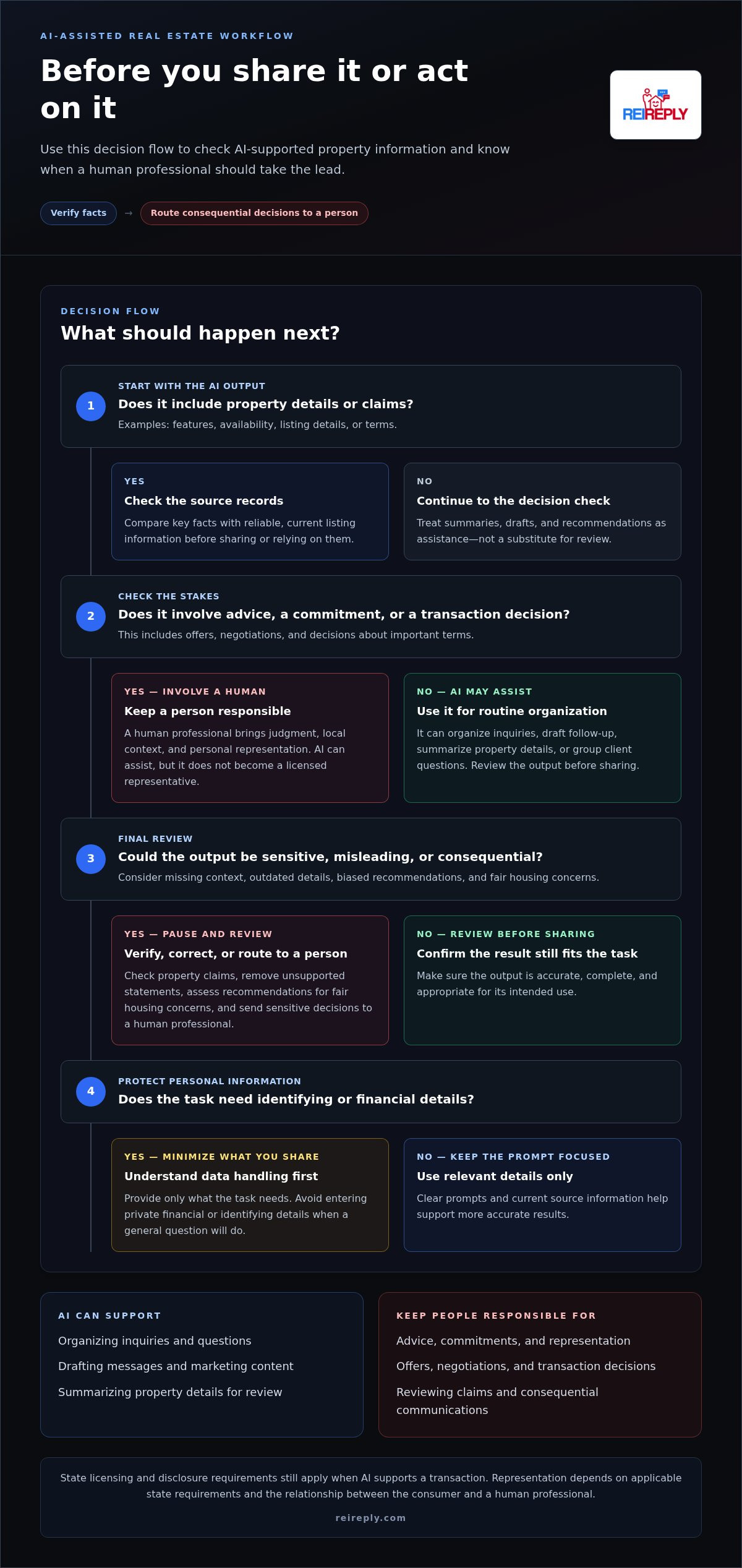
An AI system can organize inquiries, draft follow-up messages, and summarize property details. A human agent brings negotiation judgment, local context, and personal representation. Compare tools by the specific work they handle, such as sorting buyer questions or preparing an email draft. Keep people responsible for advice, commitments, and transaction decisions.
No. AI software can assist with real estate work, but it does not become a licensed representative. Representation depends on applicable state requirements and the relationship between the consumer and a human professional.
State licensing and disclosure requirements still apply when AI supports a transaction. Have a human review property descriptions, recommendations, and communications, and assess outputs for fair housing concerns before sharing them with buyers or sellers.
Buyers and sellers can use an AI tool in a clear sequence:
- Describe the goal, such as finding homes with a specific feature.
- Review suggested properties and compare details against current listing information.
- Use AI to organize questions, then discuss important terms with a human agent.
- Keep a person involved in offers, negotiations, and transaction decisions.
A tool’s geographic coverage and access to useful local property information affect what it can do. It may answer inquiries, organize listing details, or help prepare marketing content, depending on the platform.
Start with tools that address a defined workflow. The REALTORS® Technology Report dated September 18, 2025 identifies social media, CRM, and local MLS as the tools producing the highest number of quality leads in the preceding 12 months. For marketing, augmented reality may increase conversion rates by up to 40% and reduce staging costs by up to 97%.
Risks include outdated listing details, incorrect summaries, biased recommendations, and messages that miss important context. Treat AI output as a draft, verify property claims against reliable listing records, and route sensitive or consequential decisions to a human professional.
Data Accuracy and Information Security
Accuracy depends on current source information, correct property matching, and clear prompts. A tool may summarize a listing, but changed availability or incomplete details can affect the result. Check key facts, such as property features and terms, against the underlying records before sharing them or relying on them to make a decision.
Security depends on how a tool controls access, stores information, and handles personal details. Provide only the information needed for the task, and understand the tool’s data handling before entering financial or identifying details. For example, ask a general property question instead of including a buyer’s private financial history.
AI applications for real estate professionals
Real estate teams can use AI for specific tasks, not just general automation. Start with one job, such as drafting a listing description, summarizing a property inquiry, or creating social media copy. Define the expected output, provide relevant details, and review the result before sharing it with clients.
For property marketing, AI can turn verified listing facts into several content formats. Provide features such as a renovated kitchen, nearby transit, and an open floor plan. Ask for a concise listing draft, a social caption, and an email version. Check each claim against the source information before publishing.
Visual tools can help people picture a space with a different layout or style. For example, a seller might use a virtual staging concept to show how an empty living room could look furnished. Label illustrative visuals clearly and distinguish actual property features from design suggestions.
AI can also help professionals prepare for conversations. It can group a buyer’s questions about commute access, storage, or renovation needs into themes. An agent can use that summary to plan a property tour or identify questions that need direct answers. The tool organizes information; the professional applies local context.
To prepare for a market discussion, ask AI to organize a comparison of selected properties using relevant criteria. Identify the area, choose useful property features, and review the source records before drawing conclusions. Treat the output as an organizing aid, not a substitute for current market evidence or professional judgment.
- Listing preparation: Draft descriptions from supplied property facts, then verify every detail.
- Marketing content: Adapt approved listing information for email and social media.
- Client preparation: Turn inquiry notes into a focused list of tour questions.
- Visual planning: Create illustrative staging concepts without changing actual property facts.
Set guardrails before using a workflow. For a listing draft, specify the intended audience, factual details, and tone. Ask the tool to flag missing information rather than fill gaps. An agent should remove unsupported claims, confirm important wording, and decide whether the final material accurately represents the property.
Assess usefulness by comparing the work involved. Track the time needed to prepare a listing manually against the time spent prompting and reviewing an AI draft. If revisions take longer than the original task, improve the instructions or choose a different application. Keep the process only if it improves a real workflow.
For a practical next step, explore AI workflows for real estate lead operations and consider which repetitive tasks are suitable for automation.
Automated follow-up by call, text, and email
A practical follow-up sequence gives each channel a clear purpose. Let the lead’s inquiry, preferred contact method, and next step guide every message.
Automated Follow-Up Calls
An automated call can acknowledge an inquiry, ask what the prospect needs, and capture useful details. For example, after a buyer asks about a property, the system can ask whether they want listing details or to speak with an agent. Review call scripts for accuracy, natural wording, and a clear handoff when a question requires human judgment.
Keep the call focused. Open by identifying the reason for calling and inviting a response. If the prospect asks about offer terms or property condition, route the conversation to a human instead of improvising an answer.
Automated Follow-Up Texts
Text follow-up suits short updates and simple next steps. After a property inquiry, an automated message might confirm the address and ask whether the person wants a tour or more information. Ask one clear question per message and make the reply path obvious.
Personalize texts using details from the inquiry, not assumptions. A message about a specific listing feels more relevant than a generic check-in. Record communication preferences, honor requests to stop, and send complex questions to an agent for a thoughtful response.
Automated Follow-Up Emails
Email gives prospects room to review more detail. A follow-up can summarize the property they asked about, include verified listing information, and offer a next step, such as a conversation. Use a specific subject line and make the message easy to scan.
For example, after a seller requests information, an email can recap their stated goals and list questions for a discussion with an agent. Review every property fact before sending. AI can draft and organize the message, but an agent should approve claims and commitments.
Coordinate channels instead of sending the same message everywhere. A workflow might begin with a call after an inquiry, followed by a text if the person requests written details. Send an email when the prospect needs a fuller summary. Use the interaction history to avoid duplicate or contradictory messages.
- Capture the inquiry source, property, and requested next step.
- Select a suitable channel based on the prospect’s preference.
- Personalize the message using verified details from the inquiry.
- Route questions, objections, or sensitive topics to a human agent.
- Record the outcome and adjust the next follow-up accordingly.
Define clear stop points before automating. If a lead says they have already found a home, pause the sequence and update the record. If they ask about a property’s condition, flag the question for direct review. A useful system responds to what people say instead of blindly repeating a preset message.
Assess quality through useful outcomes: answered questions, relevant conversations, and effective handoffs. Review sample calls, texts, and emails regularly. Remove outdated listing details, awkward scripts, and messages that do not match the prospect’s request. That is how automation can support follow-up while leaving relationship decisions to human judgment.
What tasks can AI real estate agents handle for buyers, sellers, and renters?
AI can organize information and handle routine communication for different property goals. A buyer comparing homes, a seller preparing a listing, and a renter asking about availability each need a different workflow.
For buyers
A buyer can describe priorities such as a home office, a ground-floor bedroom, or access to a particular commute route. AI can organize those preferences into a search checklist and help sort property details against it. The buyer can then review matching listings and identify questions for a human agent.
Before a tour, AI can turn a listing into a visit plan. For a home with a finished basement, the buyer might ask about permits, drainage, or intended use. The tool can collect these questions, but the buyer should get property-specific answers from the responsible professional.
After a showing, a buyer can dictate notes about layout, repairs, and preferred features. AI can group the notes by property to make comparisons easier. A human agent can help interpret trade-offs and guide decisions involving an offer or contract.
For sellers
A seller can use AI to organize information before marketing a property. For example, they can group details about recent improvements, room features, and outdoor spaces. AI can turn those notes into a draft listing description or social post for review.
AI can also help prepare for buyer inquiries. If a buyer asks about a roof replacement, the system can surface the seller’s documented information or flag the question for follow-up. It should not invent a date, warranty, or condition statement when those details are unavailable.
For pricing conversations, AI can organize comparable property details selected by the agent. Sellers can use that information to prepare questions about location, condition, and features. Pricing decisions still require current evidence and professional judgment, not an automated summary alone.
For renters
A renter can state practical needs such as pet policies, parking, laundry, or move-in timing. AI can turn them into a checklist and help compare available property information. The renter can then ask focused questions about details that affect their choice.
For example, someone seeking an apartment that allows a dog can ask the tool to identify pet-policy details in supplied listings. The renter should confirm the actual terms before making a decision. AI can also summarize viewing notes about storage, noise, and transit access.
Across all three groups, useful automation starts with a clear task. Define the goal, provide relevant details, and review the result before acting. An AI voice agent can handle an initial inquiry by asking what property or service the person needs, then capturing the response for follow-up.
Keep consequential steps with people. Buyers need human guidance for negotiations, sellers for decisions about property claims, and renters for lease terms. AI can collect questions, summarize information, and prepare the next conversation. It cannot replace a person’s judgment about a client’s priorities or a transaction’s details.
How does an AI real estate agent compare with a human real estate agent?
An AI system and a human agent bring different strengths to a real estate workflow. AI can process inquiries, organize details, and prepare routine responses. A human can interpret context, build trust, and guide decisions. Compare them task by task: identify what needs speed, what requires judgment, and where both should work together.
For example, AI can sort buyer inquiries by property preference and draft an initial reply. A human agent can then discuss trade-offs, ask follow-up questions, and explain how a home fits the buyer’s needs. This division keeps routine organization moving while reserving personal attention for consequential conversations.
Consistency is another difference. An AI workflow can follow the same approved steps for each inquiry, such as recording a requested tour or routing a question. A human agent can adapt when a seller is anxious about timing or a buyer changes priorities. That flexibility matters when a conversation moves beyond a standard script.
- Speed: AI can process routine tasks quickly; people decide what deserves immediate attention.
- Context: AI works from supplied information; agents can ask clarifying questions and interpret nuance.
- Judgment: AI can organize options; humans weigh priorities and explain trade-offs.
- Personal connection: Automation can keep communication moving; agents build relationships through direct conversation.
- Accountability: A human should review consequential statements and guide transaction decisions.
Set a clear handoff. If a prospect asks an automated system about a property’s basic features, it can provide approved information. If they ask whether a particular offer is strategically wise, the system should direct them to a human agent. The same boundary applies to seller concerns about disclosures and renter questions about lease terms.
To compare options, list the tasks you want handled and mark each as routine, judgment-heavy, or sensitive. Test an AI workflow on a routine task, such as sorting new inquiries. Check whether the result is accurate, understandable, and easy for an agent to act on. Keep human oversight where mistakes could affect a client’s choices.
A blended approach works best when responsibilities are clear. Define which messages AI may draft, which answers need review, and which conversations go directly to an agent. For example, AI can prepare a summary of a buyer’s stated needs while the agent leads the consultation and confirms next steps. Live human support and training can help teams use those handoffs consistently.
Want to put routine lead conversations into a clearer workflow? Explore AI voice agent workflows for real estate follow-up.
REI Reply
REI Reply gives real estate investors an AI-powered system for lead generation, qualification, and deal booking. Its AI Contact Center and AI Voice Agents support inbound and outbound conversations across calls, texts, emails, and social media, helping teams manage prospect interactions in one workflow.
The AI Ads Platform supports lead generation, while the broader platform helps organize follow-up as inquiries arrive. Consider REI Reply when your team needs a connected way to handle prospect communication and move qualified leads toward a deal. Human judgment still matters for negotiation, advice, and transaction decisions.
Contact REI Reply to explore how its tools can support your lead follow-up workflow.
Put your next follow-up improvement in motion
Choose one point in your lead process where a clearer response could make the next conversation easier. Map what happens from a new inquiry to a human handoff, then decide which steps benefit from automation and which need personal judgment. This gives your team a practical starting point for using an AI real estate agent without handing over important decisions.
For real estate investors exploring that next step, REI Reply offers an AI Ads Platform alongside its contact center tools. Consider how advertising and lead conversations fit together in your workflow, then decide what you want to improve first. Starting with a specific task makes it easier to assess whether the system supports your process.
Explore the available options and choose a next step that suits your operation. Contact REI Reply to discuss your lead workflow. Build a process that keeps conversations moving and gives your team more room to focus on meaningful decisions.
Frequently Asked Questions
What is an AI real estate agent and how does it work?
An AI real estate agent is software that assists with defined property workflows. For example, a seller inquiry can prompt the system to identify intent, retrieve approved information, and draft a response. The workflow can record the inquiry for a person to review or handle next. The term describes software support, not a human representative; people remain responsible for advice, commitments, and transaction decisions.
Which AI platforms are best for real estate professionals in the United States?
The best fit depends on the work, business model, and tasks a platform supports. An AI real estate agent platform for real estate investors may focus on property acquisition and lead conversations, while other workflows may have different priorities. Compare how each option handles inquiries, what capabilities it includes, and whether it fits your team’s process. Choose based on the work you need done, not the platform label alone.
How much do AI real estate agents and tools cost?
Costs depend on a platform’s billing model and the capabilities a team needs. Compare subscription tiers, user licensing, communication usage, integrations, and optional features. For example, list the workflows your team expects an AI real estate agent tool to support, then separate included features from add-ons. Review recurring charges and usage limits to compare the overall fit, not just the headline price.
What state licensing, disclosure, and fair housing rules apply to AI in real estate?
State licensing and disclosure requirements still apply, and AI software does not become a licensed representative. Have a human review property descriptions, recommendations, and communications, and assess outputs for fair housing concerns.


