
AI-Driven Communication Tools for Real Estate Leads
Real estate lead generation takes more than a website form. AI-driven communication for real estate leads can combine chatbots that capture inquiries, tools that help prioritize prospects, and automated email and text follow-up to keep conversations moving. CRM-connected routing can direct each inquiry to the right team member, while human review helps keep outreach relevant and accountable.
Fast responses and consistent follow-up matter, but automation works best when it supports genuine conversations rather than replacing them. The right tools can help your team identify promising prospects, tailor outreach to their behavior, and track interactions without losing sight of human judgment. This guide covers the main tools for real estate lead generation, what each one does, how to personalize follow-up, and safeguards for accurate, transparent communication.
Key Takeaways
- Match lead-generation tools to the job: capture inquiries, identify intent, and route prospects to the right person.
- Build automated email, text, and direct-mail sequences around timely, relevant follow-ups, then review them before scaling.
- Use engagement signals to tailor outreach and prioritize leads showing stronger interest.
- Keep AI communication accountable with human review for accuracy, fairness, tone, and local relevance.
- Assess customer testimonials and reported outcomes carefully to understand what a tool can support without assuming results are guaranteed.
What Tools Help Real Estate Lead Generation?
Real estate lead generation tools work best as a connected system, not a pile of disconnected apps. A website chatbot can answer questions and capture visitor details around the clock, including whether someone wants a valuation, has a moving timeline, or needs a next step. AI-driven communication for real estate leads can connect those signals to qualification, routing, and follow-up.
Choose tools based on the job they do. A chatbot captures inquiries; lead intelligence helps prioritize prospects; a CRM keeps contact history and assigned tasks in one place. AI Voice Agents can handle inbound and outbound conversations, while agents focus on qualified prospects and decisions that call for human judgment.
- Website chatbots: Capture contact details and ask focused questions about property type, location, valuation interest, and timing. Use clear prompts so prospects know what information they’re sharing.
- Lead-scoring tools: Rank prospects using signals such as email opens, website visits, saved searches, and repeat inquiries. A person revisiting listings and asking about a valuation may deserve quicker attention.
- CRM and marketing automation: Store interaction history, trigger relevant messages, and create tasks when a prospect’s activity changes. These tools are useful for nurturing contacts who aren’t ready to speak with an agent yet.
- Routing and scheduling tools: Assign inquiries by geography or property type, then offer appointment scheduling. A neighborhood-specific inquiry can reach an agent familiar with that market.
- AI-powered ad tools: Support lead generation by helping teams attract prospects through campaigns, while chatbots and CRM workflows manage the next interaction.
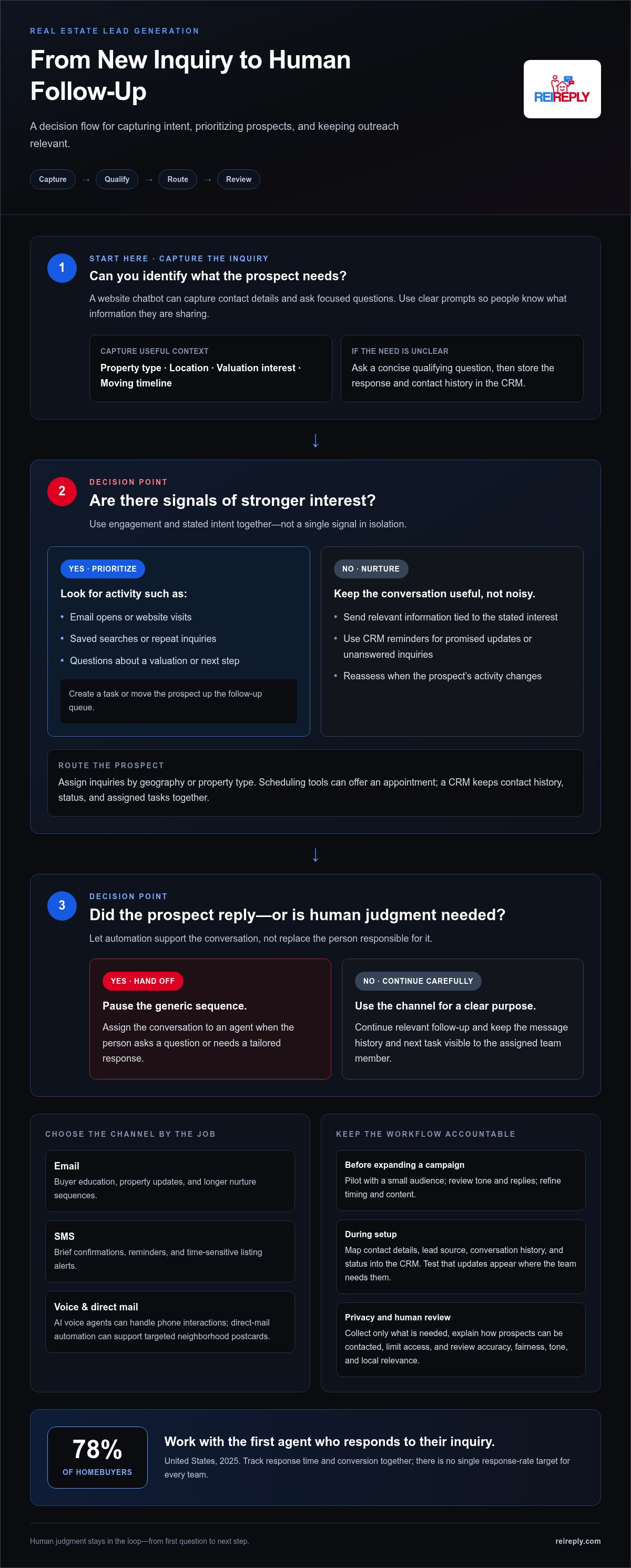
To set up AI qualification and follow-up, connect your communication tools to the CRM, choose a concise set of qualifying questions, and define the signals used to prioritize leads. Then create follow-up steps for each lead category, assign a human owner, and review sample conversations before expanding the workflow.
Respond as soon as a new inquiry arrives, then route it to an agent who can continue the conversation. In the United States, 78% of homebuyers work with the first agent who responds to their inquiry (2025). No single response-rate target fits every team; track response time and conversion together to see which follow-up process performs best.
Connect the CRM and AI messaging platform through an integration or approved data connection. Map contact details, lead source, conversation history, and status, then test that updates appear where your team needs them. A consistent contact record helps agents avoid relying on scattered inboxes for follow-up.
Build privacy review into setup. Limit collection to information needed for qualification, explain how prospects can be contacted, and restrict access to lead records. CCPA violations can cost up to $7,500 per incident, according to the California Privacy Protection Agency. A documented review process helps teams manage exposure while using AI tools responsibly.
Automated email, text, and direct-mail outreach
A follow-up platform turns each captured inquiry into a planned conversation. Email automation suits detailed property updates and buyer guides. SMS works for brief reminders, new listing alerts, and appointment coordination. Direct-mail automation can deliver neighborhood-focused postcards when a physical message fits the campaign. Use each channel for a clear purpose, not just more touches.
Start with the lead’s source and stated interest. A buyer requesting homes in a specific area could receive relevant listing alerts, followed by a personal message from an agent. A homeowner exploring a sale could receive valuation-related information and an invitation to discuss next steps. Tie each message to the prospect’s request so the outreach feels relevant, not generic.
AI tools can help draft and organize campaigns, while automation platforms send messages based on contact status or activity. Useful categories include:
- Email nurture tools for buyer education, listing updates, and longer follow-up sequences.
- SMS automation tools for concise confirmations, reminders, and time-sensitive property alerts.
- AI voice agents for handling phone conversations, asking qualifying questions, and directing prospects toward an appropriate next step.
- Direct-mail automation for targeted postcards and neighborhood campaigns coordinated with digital outreach.
Seasonal campaigns give teams a timely reason to reconnect. Prepare spring-move content before the busy season, and create messages around school catchment deadlines for families planning a move. A Christmas slowdown can suit a low-pressure check-in; a new-year fresh-start campaign can invite prospects to revisit their plans. Adapt each message to the recipient’s location and goals.
Automated email and SMS nurturing should respond to meaningful actions, not send every contact the same sequence. After a prospect requests listing updates, for example, send relevant options and an easy way to adjust preferences. If the person replies with a question, pause the generic sequence and assign the conversation to an agent. Reminders can also flag unanswered inquiries, upcoming appointments, or promised listing updates.
Which AI tools automate real estate lead follow-up by text, email, and phone? Email and SMS automation manage written sequences, while AI Voice Agents handle phone interactions. A connected CRM can keep message history and the next task visible to the assigned agent.
Pilot each campaign with a small audience, review message tone and replies, then refine timing and content before expanding. Use AI-powered real estate campaigns to connect advertising with follow-up planning.
Behavior tracking and personalized follow-ups
Behavior tracking turns a prospect’s activity into useful context for the next conversation. An AI tool can combine email engagement, listing views, saved searches, and repeat inquiries. For example, a contact who opens several emails and views listings twice in one week may be a hot lead. That pattern deserves timely, personalized attention, not another generic nurture message.
Signals need context. A single listing view may reflect casual browsing, while repeated visits to similar homes can indicate a specific search. An agent should compare the prospect’s actions with stated preferences, location, and timeline before choosing the next step. This makes lead nurturing more relevant without treating every click as proof of intent.
Different tools support different parts of the workflow:
- CRM activity tracking keeps email opens, website visits, saved searches, and agent notes together. It helps teams see a prospect’s engagement history before responding.
- Marketing automation can trigger a follow-up after a defined behavior, such as returning to a listing or submitting a property inquiry. It’s useful for timely reminders and tailored content.
- Predictive lead scoring combines multiple signals to prioritize follow-up. Teams can rank leads by activity and fit, then direct higher-intent prospects to an agent.
- ChatGPT and similar generative AI tools can draft a first version of a personalized email using approved property details. An agent should review the draft and add relevant human context.
Build behavior-triggered follow-up around clear actions. If a prospect saves a search, send an update that reflects those preferences. If someone revisits a listing, share useful details about the property and offer a conversation. When a contact asks about valuation or timing, assign the inquiry for direct agent follow-up instead of sending an unrelated sequence.
Set practical rules before enabling automation. Define which actions trigger a message, what information it may use, and when the sequence pauses. For example, stop automated reminders when a prospect replies, books a meeting, or asks to speak with an agent. This helps prevent a canned prompt from arriving after a real conversation has begun.
Review engagement patterns regularly. Compare which triggers lead to replies, appointments, or continued browsing, then adjust the workflow based on what you observe. Treat a score as a prioritization aid, not a final verdict. Agent notes may reveal motivation that clicks alone cannot capture, such as a changing move date or interest in a property that is not yet listed.
Transparency, human oversight, and accountability
AI can prioritize inquiries and draft messages, but real estate agents remain responsible for the conversation. Before a campaign goes live, review each message for tone, accuracy, fairness, and local relevance. For example, check that a property description reflects the listing and that a neighborhood reference fits the intended audience.
Human oversight should shape the workflow, not appear only after a problem. Assign an agent to review AI-generated content, handle complex replies, and take over when a buyer or seller asks for personal guidance. Automation should support the client relationship, not replace its human element. Lead-generation AI works best alongside agent follow-up and judgment.
Use tools for defined accountability tasks:
- AI conversation review: Flag messages that need a human response, such as a seller asking about a valuation or a buyer raising a concern.
- CRM activity records: Keep communication history, assigned ownership, and next steps connected so an agent can see what a prospect has already received.
- Documentation workflow tools: Route documents for review and make the next responsible person clear. This supports compliance oversight without treating automation as a substitute for professional review.
- Performance dashboards: Track lead response times, conversion rates, closing-cycle length, administrative workload, and agent productivity. These measures help teams see where AI supports work and where people need to intervene.
Build transparency into the client experience. Give buyers and sellers clear updates at meaningful transaction milestones, such as when documents move to review or an agent is waiting for a response. A CRM task can prompt the assigned agent to send an update, while a human checks that it reflects the actual status.
Accountability also means testing what the system predicts. If an AI tool prioritizes one prospect over another, agents should be able to review the engagement signals behind that decision. Compare the ranking with the prospect’s stated needs and agent notes. A high score should guide attention, not determine who receives service.
Connect communication records, lead intelligence, and review tasks so each handoff has an owner. For example, an AI-generated SMS can be logged in the CRM, a reply can create a follow-up task, and an agent can document the next action. Review the dashboard regularly, then adjust prompts or routing when repeated errors appear. That process keeps automation visible, measurable, and accountable.
Customer testimonials and reported outcomes
A testimonial can show how a real estate team uses AI, but it is not a universal performance benchmark. Look for the workflow described: did automation help a homeowner receive a prompt reply, give buyers relevant listing updates, or help agents organize nurturing? A specific account of the process is more useful than a broad claim about growth.
Separate reported outcomes from evidence of what caused them. A testimonial may describe a smoother pipeline, but that alone does not show which tool made the difference. Look for context such as lead sources, communication channels, follow-up process, and measurement period. Without those details, treat the story as an example of use, not proof of a typical result.
Use a CRM and performance dashboard to assess outcomes in your own operation. Record a baseline before changing the workflow, then compare the same measures afterward. Keep lead source and campaign type visible so changes in listing demand are not mistaken for an automation effect.
- Response time: Track how quickly agents respond to new inquiries and whether automation reduces delays.
- Conversion rates: Compare the share of leads progressing to meaningful next steps, segmented by source or campaign.
- Closing-cycle length: Monitor whether communication workflows help transactions move through their stages more smoothly.
- Administrative workload and agent productivity: Review whether agents spend less time on repetitive tasks and more time speaking with buyers and sellers.
What metrics measure the ROI of AI-driven real estate lead communication? Compare response times, conversion rates, closing-cycle length, administrative workload, and agent productivity. Consider them together: faster replies are most useful when they support relevant conversations and pipeline progress.
Build a clear measurement routine. First, record the current process and define what counts as a qualified inquiry or conversion. Next, tag leads by source and communication path in the CRM. Then review dashboard results with agents, including examples where a message led to a reply, appointment, or continued nurturing. This connects reported outcomes to observable actions.
Use call and message reviews to assess quality as well as volume. Sample conversations with buyers and homeowners to see whether messages answered their questions and clarified the next step. Ask agents about missed context, repetitive wording, and useful automation. Use those observations to refine prompts and workflows.
Judge testimonials by their detail, relevance, and measurable context, then apply the same discipline to your own pipeline. Explore AI lead communication workflows to see how automated conversations can fit into your follow-up process.
REI Reply brings lead generation and communication together in an AI-powered platform built for real estate investors. Its AI Contact Center brings lead conversations together, and AI Voice Agents can handle inbound and outbound calls. The AI Ads Platform supports campaign-driven lead generation.
This approach can suit investors who want to connect outreach with lead qualification and follow-up instead of managing each interaction separately. The workflow should still reflect your lead sources, communication process, and points where prospects need human attention. REI Reply also provides Live Human Support & Training for users working with the platform.
If you’d like to explore how REI Reply could fit your communication workflow, visit reireply.com.
Build Your Next Lead Workflow With Purpose
Make your next campaign a focused test, not a full-scale overhaul. Choose one lead source and one communication gap, then define who owns each handoff. This gives your team a practical way to assess how the workflow fits daily operations before expanding it.
AI-driven communication for real estate leads works best when the technology supports a process agents can explain and manage. Set a review point, gather agent feedback, and use what you learn to refine the next campaign. The goal is a repeatable system that helps your team stay responsive while keeping relationships personal.
REI Reply offers an AI Contact Center and an AI Ads Platform for real estate investors looking to connect marketing with lead communication. Choose the next step that fits your workflow, and contact REI Reply to explore the platform. A more deliberate lead process starts with one practical change.
Frequently Asked Questions
What is AI-driven communication for real estate leads?
It uses artificial intelligence to support conversations with prospective buyers and sellers across channels such as chat, email, text, and phone. For example, a website inquiry can be organized with the prospect’s question and contact details, then passed to an agent for a relevant response. The technology helps manage communication tasks, while agents provide context, judgment, and the personal guidance each transaction requires.
How much do AI communication tools for real estate agents cost?
Costs depend on the platform’s capabilities, communication channels, usage, integrations, and support. A basic messaging tool and a broader contact-center system serve different needs, so compare the features included and any usage-based charges. For a specific service, the price depends on the case and is provided after a quote request. Assess the total cost against the workflow the tool will replace or support.
How do AI real estate lead-response tools compare in features and pricing?
Compare tools by their primary function: chatbots capture initial inquiries, CRM features organize contact records, messaging platforms automate written follow-up, and voice agents handle phone conversations. Then assess channel coverage, reporting, integration options, human handoff, and support. Pricing depends on the features, usage, and service model. A side-by-side checklist can show whether a focused tool or connected platform better fits your team.
How can AI personalize communication for buyers, sellers, and different lead sources?
Use the person’s stated goal and inquiry source to shape the message. A buyer arriving through a listing form might receive information about that property, while a homeowner requesting a valuation needs a different conversation. Keep the source, preferences, and prior messages attached to the contact record. Review generated copy before sending, and update the record if the person corrects details or changes plans.
What U.S. laws govern AI calls and texts to real estate leads, including TCPA and CAN-SPAM?
The Telephone Consumer Protection Act (TCPA) is relevant to telephone calls and text messages, while CAN-SPAM covers commercial email. Address each channel separately in your outreach procedures. Keep records of how contact details were collected, the communication preferences provided, and requests to stop messages. Document who reviews campaigns and how suppression requests are applied. Federal and state rules may both matter, so build compliance review into campaign approval and recordkeeping.
What privacy, accuracy, and fair housing risks come with AI communication in real estate?
AI may expose personal details in messages, use outdated property information, or generate language that unfairly excludes or steers prospects. Limit access to contact records, use approved data in drafts, and review messages for accuracy and fairness before sending. Verify listing status and remove unsupported claims about who a neighborhood suits. Keep a human responsible for correcting errors and handling sensitive questions.


