
AI Appointment Setter for Real Estate Investors: 2026 Guide
What if a seller inquiry arrived while you were busy, but the follow-up still moved toward a useful conversation? An ai appointment setter for real estate investors can manage early engagement and support booking a next step. The booking itself is only part of the process: your team also needs relevant seller and property context to decide what happens next.
Seller leads don’t always arrive when you’re ready to respond. Manual follow-up can also take time without clarifying whether the seller, property, or timeline fits your acquisition criteria. A useful workflow does more than put a name on the calendar. It captures what the seller shared, identifies what remains unclear, and gives your team a reason for the next conversation.
This guide explains how AI appointment setting can fit into an investor workflow, what to ask during qualification, and how to pass useful details to the next person. You’ll also learn how calls, texts, emails, and social interactions can work together, what to measure, and what to consider when evaluating a platform such as REI Reply. The goal is to make each booked conversation more actionable, without assuming every lead will become a deal.
Key Takeaways
- An ai appointment setter for real estate investors should move seller leads toward a qualified acquisition conversation, not simply fill a calendar.
- Map the workflow from lead intake through two-way engagement, qualification, booking, and team review so each next step is clear.
- Set qualification rules around seller fit and the property details your team needs before deciding what happens next.
- Track contact attempts, qualified leads, bookings, attended calls, and resulting opportunities separately to see where your process needs attention.
- Compare follow-up methods by how well they capture context, handle channels, and leave room for human judgment. REI Reply brings investor lead engagement capabilities into one platform.
What an AI Appointment Setter for Real Estate Investors Actually Does
An AI appointment setter for real estate investors is software that engages leads, asks configured questions to gather qualifying details, and supports booking a next conversation. It can organize the first stage of seller communication, but it doesn’t make acquisition decisions for your team. Artificial intelligence refers broadly to systems that perform tasks associated with human intelligence; What is Artificial Intelligence? offers a foundational overview.
The investor use case is distinct from scheduling a property showing, buyer consultation, or customer-service appointment. An acquisition conversation helps your team assess whether a property and the seller’s situation merit a closer look. The goal is not just to schedule a call, but to give the people evaluating potential deals a relevant starting point.
An appointment is a scheduled conversation. A qualified opportunity is a lead with enough relevant seller and property context for the acquisition team to assess a next step. An appointment setter can help gather that context and book a conversation. It can’t guarantee that the seller attends, that the property fits, that an offer follows, or that a transaction closes.
Which investor conversations can an AI setter move forward?
Motivated-seller inquiries are a central use case. An initial exchange can clarify why the seller is considering a sale, what they’re willing to share about the property, and what kind of conversation they want next. Those details help the acquisitions team prepare instead of starting without context.
Qualification should reflect your operation. An investor focused on a particular property type may need different information from one using another acquisition strategy. Define questions around your criteria, and give the system a clear way to record unknown or unanswered information. A single fixed script won’t suit every investor or seller conversation.
What counts as a useful appointment for an investor?
A useful appointment is relevant to your acquisition criteria and gives the team enough context to make the conversation purposeful. Not every answer needs to meet a rigid threshold before a call is booked. The appointment’s purpose and the information available should be clear enough for a person to decide how to proceed.
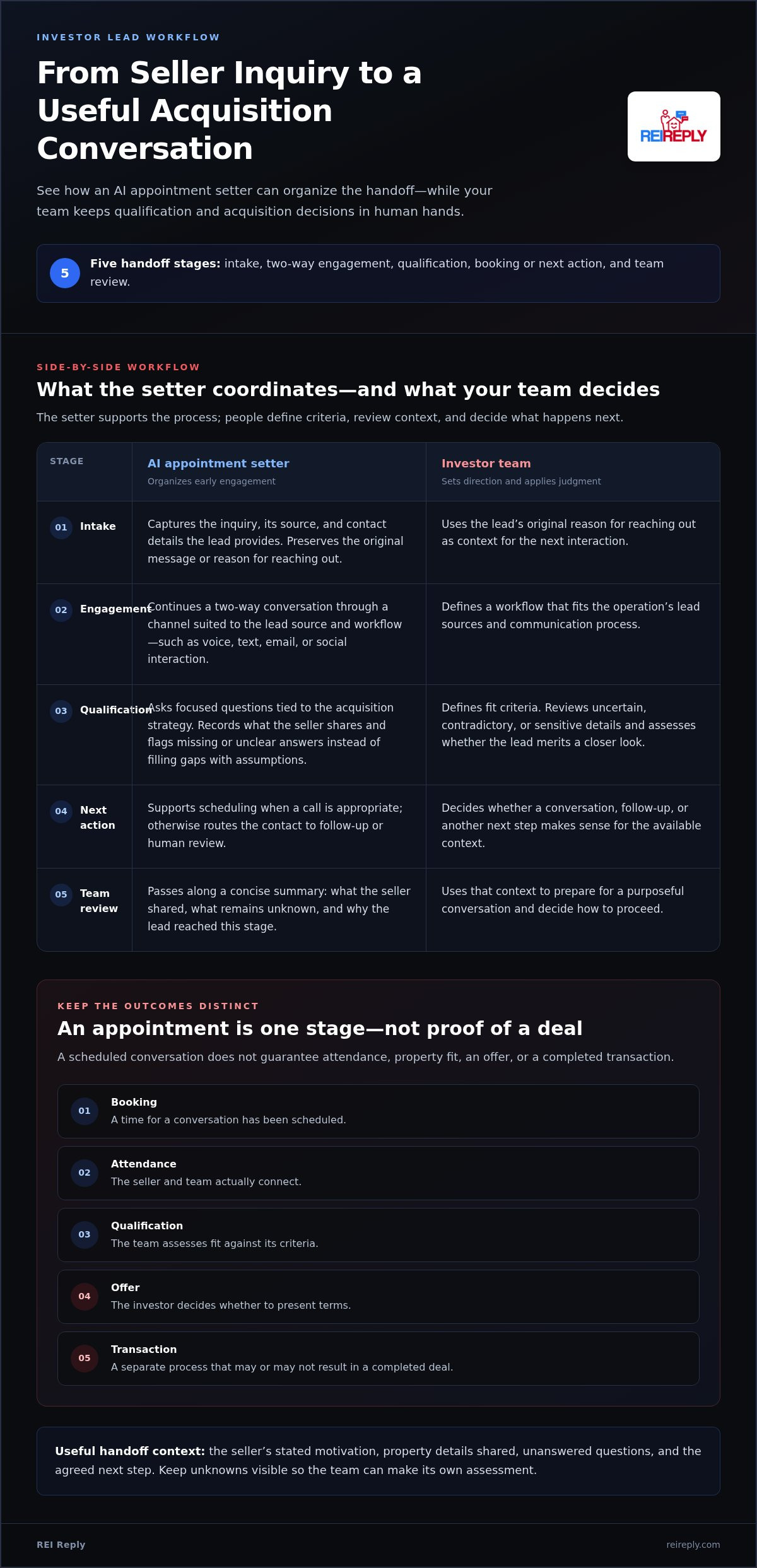
- Booking: A time for a conversation has been scheduled.
- Attendance: The seller and team actually connect.
- Qualification: The team assesses fit against its criteria.
- Offer: The investor decides whether to present terms.
- Transaction: The parties move through a separate process that may or may not result in a completed deal.
Keep these outcomes distinct. A booked appointment doesn’t prove attendance or deal potential. Notes on the seller’s stated motivation, property details shared, unanswered questions, and agreed next step help the human team prepare without treating assumptions as facts. This is where automation can support acquisition work without replacing judgment.
How AI Appointment Setting Moves a Seller Lead Toward a Conversation
A seller lead needs a clear path from first contact to a useful next step. An AI appointment setter for real estate investors can help coordinate that path, but the sequence should match your lead sources, acquisition criteria, and team process. Treat it as a managed handoff, not a booking button operating on autopilot.
- Intake: Capture the inquiry, its source, and the contact details the lead provides. Preserve the original message or reason for reaching out so the next interaction has a clear starting point.
- Two-way engagement: Continue the conversation through a channel suited to the lead source and your workflow. An inbound call may call for a voice response, while another lead may be handled through text, email, or social interaction.
- Qualification: Ask focused questions tied to your acquisition strategy. Record what the seller is willing to share, and note missing or unclear answers rather than filling gaps with assumptions.
- Booking or next action: If a call is an appropriate next step, support scheduling the conversation. Otherwise, route the contact to the follow-up or human review your process calls for.
- Team review: Give the person taking the conversation a concise summary of what the seller shared, what remains unknown, and why the lead reached this stage.
From first inquiry to seller qualification
Start with the information that helps your team understand the inquiry: who is contacting you, which property they’re discussing, what they’ve said about selling, and any timing they’ve volunteered. Keep questions short and relevant. If your acquisition strategy focuses on a particular property profile, set criteria that reflect it rather than relying on a generic checklist.
Make room for uncertainty. If an answer is contradictory, sensitive, or hard to categorize, preserve the seller’s wording and flag it for human review. Don’t force a confident label when the conversation doesn’t support one. For more on how voice interactions can be designed and managed, explore this AI voice agent guide.
From qualification to a booked acquisition conversation
When the criteria point to a relevant next conversation, the setter can help move the lead toward an appointment. Make clear what the call is for and who is expected to take it. If the lead isn’t ready to book, define an alternative next action so an uncertain exchange isn’t mistaken for a confirmed appointment.
Keep the handoff practical. Include the seller’s stated intent, available property details, preferred next step, and open questions. The acquisitions team can then prepare without mistaking a preliminary answer for a verified fact. REI Reply brings voice, text, email, and social engagement together with lead qualification and contact management. See how REI Reply supports investor lead workflows.
AI Appointment Setter vs. Manual Follow-Up, VAs, and Basic Dialers
Each follow-up method handles a different part of the acquisition workload. Manual outreach gives your team direct control, a human assistant can manage conversations, and a basic dialer helps place calls. An AI appointment setter for real estate investors can combine configured engagement, qualification, and booking steps. The useful question isn’t simply “human or AI?” It’s which tasks need consistency and which require judgment.
| Approach | Response coverage | Qualification and context | Channels | Human judgment |
|---|---|---|---|---|
| Manual follow-up | Depends on staff capacity and availability | Can adapt to each lead; consistency depends on the person and process | Handled manually across chosen channels | Direct human control |
| Human assistant | Depends on assigned hours and workload | Can capture context and clarify responses with guidance | Handled according to their role and tools | Can use judgment and build rapport |
| Basic dialer | Supports call attempts at configured times | Doesn’t necessarily qualify leads or capture conversation context | Primarily calling | Usually relies on a person for meaningful conversation |
| AI appointment setting | Can engage through configured workflows | Uses set prompts and records details; unclear cases need review | Can include calls, texts, email, or social interactions | Useful for structured work, not a substitute for nuanced decisions |
Where automation can improve a lead operation
Automation can handle repeatable first-contact and follow-up tasks, such as asking a consistent set of initial questions or recording details a seller provides. That gives the team a defined process instead of relying on memory or scattered notes. Consistent prompts also make it easier to spot missing information across leads. The benefit is a more structured workflow, not a guaranteed business result.
For example, an investor can define prompts about the property, the seller’s stated intent, and the desired next step, then decide which answers warrant a team conversation. The system should follow those criteria without turning every interaction into the same rigid script. A broader automated lead follow-up strategy can connect initial contact with a coherent ongoing process.
Where human judgment still matters
Seller circumstances can be complicated. A sensitive situation, unclear answer, or negotiation calls for listening and discretion, not just a sequence of prompts. People should review ambiguous responses and appointment notes, then decide how to proceed. Relationship-building and negotiation remain human-led work because they require context, empathy, and judgment.
Automation works best for structured, repeatable contact tasks. A human-led conversation is essential when a seller’s situation, trust, or negotiation requires interpretation and care. Use automation to prepare the handoff, then let the acquisitions team own the decisions. Platforms such as REI Reply’s investor contact platform bring AI engagement and lead qualification into the workflow while keeping the team central to acquisition conversations.
How to Set Qualification Rules and Measure Appointment Quality
A useful appointment starts with clear rules. Without them, an ai appointment setter for real estate investors may capture answers without showing your team whether the seller or property fits its acquisition strategy. Before automating the conversation, define what qualifies, what needs follow-up, and what should go to a person.
Booking volume alone doesn’t establish appointment quality. Measure each stage separately, then check whether the information passed to acquisitions supports a meaningful conversation.
Build investor-specific qualification criteria
Start with your acquisition strategy and lead source. Decide what your team needs to assess a seller inquiry, then classify each response as qualifying, requiring follow-up, or needing human review. Keep questions direct and respectful. Ask what the seller is willing to share rather than assuming their motivation, timeline, or circumstances.
- Seller fit: What seller intent or stated next step makes a conversation relevant to your process?
- Property context: Which details help your team assess the property against its criteria?
- Minimum information: What must be known before the lead can be routed for an acquisition conversation?
- Unclear answers: Which responses should remain unclassified until a person reviews them?
- Next step: Should the lead move to booking, receive follow-up, or go to a team member?
Make criteria specific enough to guide consistent handling, but flexible enough for different lead sources. An inbound seller inquiry may provide different context from a response to outbound outreach. Review the rules with the people taking acquisition calls so the questions and handoff match the actual workflow.
Track the metrics that reveal useful appointments
Use distinct stages rather than treating every touch as progress toward a deal. Track contact attempts, qualified leads, booked appointments, attended calls, and resulting opportunities separately. Where the data is available, compare qualified leads to bookings and bookings to attended calls. These views can reveal friction without confusing a scheduled conversation with a completed one.
Then review the records behind the numbers. Look at interactions and appointment notes across lead sources. Are key details missing? Do the qualification labels match what the seller said? Can the acquisitions team tell why the call was booked and what remains unresolved? If not, refine the criteria, prompts, or review path. Don’t optimize a metric while ignoring handoff quality.
For a product-focused look at how REI Reply fits into investor lead operations, explore this REI Reply review and strategy. If you’re ready to structure lead engagement and qualification in one investor-focused platform, explore REI Reply.
How REI Reply Supports AI Appointment Setting for Investors
Appointment setting works best when it connects to the rest of your lead operation. REI Reply is an AI-powered contact and marketing platform built for real estate investors. Its AI agents handle inbound and outbound calls, texts, emails, and social interactions. The platform supports automated lead qualification, contact management, deal booking, and CRM integration, bringing key engagement tasks into a connected workflow.
Seller inquiries don’t all arrive through the same channel. A lead might call, reply to a text, or engage through social media. Investors can use a configured workflow to engage leads, capture information, and support a next conversation instead of treating each touchpoint as a separate process. This keeps contact context connected as the lead moves through acquisition operations.
Connect appointment setting to investor lead operations
AI can support repeatable engagement and qualification across touchpoints. Contact management and CRM integration help connect those interactions to the investor’s broader lead process. The acquisitions team still owns decisions about seller fit, property evaluation, relationship-building, and negotiation. Technology can organize the work and support deal booking, but it can’t promise attendance, an offer, or a completed transaction.
To assess fit, map how your team currently handles leads:
- Lead sources: Identify where inquiries and responses originate, including calls, texts, email, and social interactions.
- Qualification rules: Define what information the team needs and which responses should be escalated for human review.
- Booking process: Set the conditions for moving a lead to an acquisition conversation, and clarify the intended next step if those conditions aren’t met.
- Context and outcomes: Decide what appointment notes the team needs and how it will review booked calls, attended conversations, and resulting opportunities.
This map shows what an AI appointment setter for real estate investors should address. If leads move between channels or contact records without a clear handoff, tighten those transitions. If the team can’t tell why an appointment was booked, improve qualification and note-taking before adding more automation.
Choose a practical next step for your team
Start with one lead source and trace its path from first interaction to team review. Identify who handles each step, what information is retained, and where a person must make a judgment call. Then compare that workflow with your acquisition criteria. This focused review can show where unified engagement, qualification, contact management, and CRM integration can support your operations.
For a closer look at REI Reply’s investor-focused approach, read the REI Reply strategy review. Once you’ve mapped your lead process, explore REI Reply for your investor appointment workflow and take the next step toward a more connected operation.
Make Your Next Seller Conversation More Intentional
Your next move doesn’t have to be a full workflow overhaul. Choose one lead source, define the information your acquisitions team needs, and decide how a lead should progress from first contact to a human conversation. Review the handoffs and refine the process as your team learns what makes an appointment useful.
An ai appointment setter for real estate investors should fit the way you acquire properties, not force your team into a generic sales process. REI Reply is built for real estate investors, bringing AI voice, text, email, and social interactions together with lead qualification, contact management, and CRM integration. Your people stay in control of acquisition judgment and negotiation while technology supports the contact workflow.
Ready to connect lead engagement to your acquisition process? See how REI Reply can power your investor lead workflow. Start with a clear process, make each handoff count, and build a stronger foundation for the conversations ahead.
Frequently Asked Questions
Can an AI appointment setter qualify real estate seller leads?
Yes. It can ask investor-defined questions and organize seller responses for review. For example, an investor might capture the property type, the seller’s stated reason for reaching out, and whether they want to discuss a sale. Treat the answers as reported information, not a final deal assessment. If a response is incomplete or unclear, route it for human review rather than forcing a qualification decision.
What does an AI appointment setter do for a real estate investor?
It helps manage early lead conversations, gather information, and support a next step such as booking an acquisition call. An ai appointment setter for real estate investors can also organize contact activity so the team can see what happened before taking over. The investor sets the criteria and decides which opportunities deserve deeper analysis. Automation supports the process; it doesn’t make investment decisions.
Can AI appointment setters handle calls and texts?
Yes. REI Reply’s AI agents handle inbound and outbound calls and support text interactions, alongside email and social interactions. This helps investors coordinate engagement across the channels in their lead workflow. For instance, a seller’s call or text can begin an exchange, while the team remains responsible for reviewing the information and deciding what to do next.
Will an AI appointment setter replace a human acquisitions specialist?
No. It can support repetitive contact, qualification, and booking tasks, but acquisitions specialists remain central to evaluating a property, responding to complex seller circumstances, and negotiating terms. A practical division is to use automation for structured information gathering, then have a team member handle conversations that require judgment or trust-building. The human remains accountable for acquisition decisions.
How do investors measure whether booked appointments are qualified?
Define what a useful call should help the acquisitions team assess, then compare the appointment record with that standard. Check whether the notes identify the property, capture the seller’s stated intent, and explain why the conversation was scheduled. Track bookings separately from attended calls and opportunities. If appointments repeatedly lack a key detail, adjust the question or handoff process instead of simply pursuing more bookings.
Does an AI appointment setter guarantee more real estate deals?
No. An AI appointment setter can support lead engagement and booking, but it can’t guarantee that a seller will attend, a property will meet your criteria, or a transaction will close. Results depend on factors beyond appointment scheduling, including the information available and the investor’s decisions. Evaluate the system by whether it supports a clear, consistent workflow and gives your team useful context for its own assessment.


