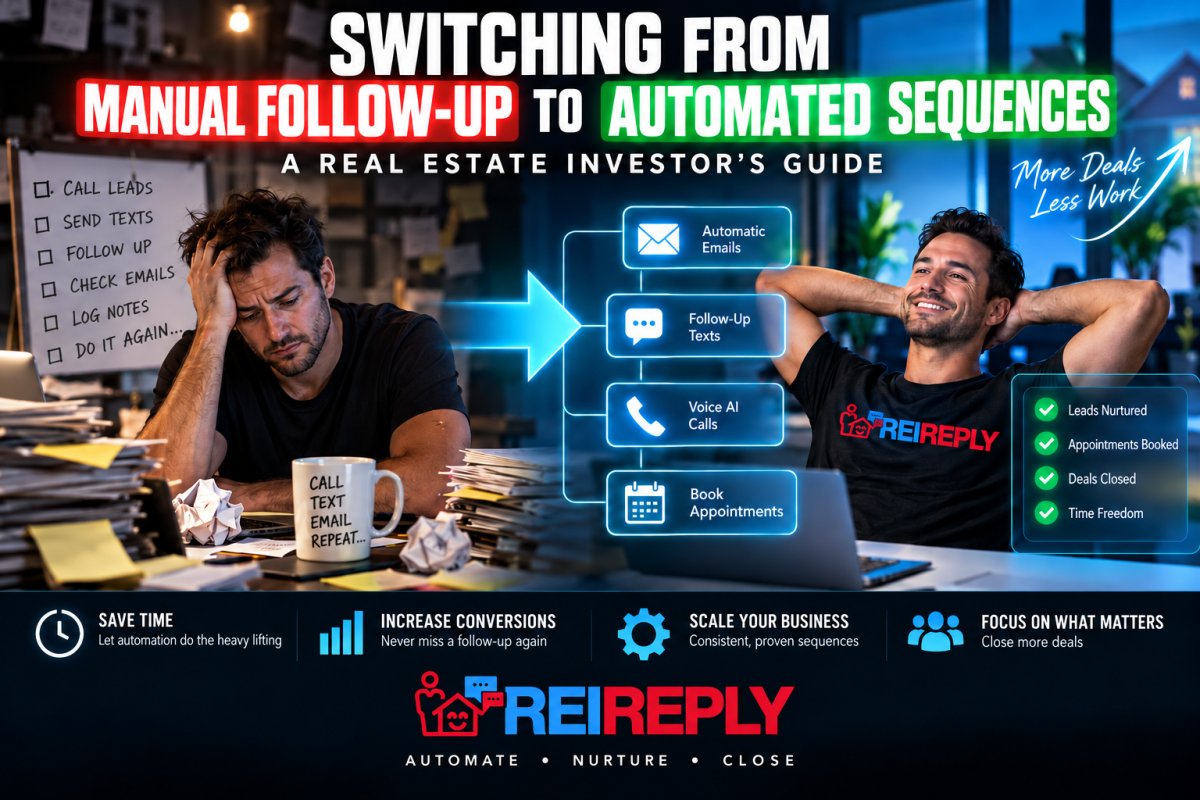
Switching from Manual Follow-Up to Automated Sequences: A Real Estate Investor’s Guide
What if switching from manual follow up to automated sequences didn’t mean giving up control of seller conversations? When the next call depends on someone’s memory, a lead can wait too long or receive different responses across channels. That’s a process problem, not a reason to automate every interaction.
It’s reasonable to be cautious about moving existing contacts and conversation history. A sequence without context can feel impersonal, and automation shouldn’t decide whether a seller is ready for a deal. The goal is to make repeatable follow-up more consistent while keeping important judgment in human hands.
This guide shows you how to identify tasks that are safe to automate first, carry lead context into a sequence, and set clear handoffs for conversations that need a person. You’ll also learn what to track to see whether the new workflow improves response consistency and team visibility. Switch in stages, preserve the seller’s story, and give your team more control over what happens next.
Key Takeaways
- Separate routine reminders from seller conversations that require human judgment before deciding what to automate.
- See how a lead can move through a sequence from initial inquiry to qualification and a clear human handoff.
- Compare manual, automated, and hybrid follow-up by process control, consistency, workload, and personalization, not promised deal results.
- Use a five-step rollout to audit your workflow, map lead stages and context, configure a sequence, pilot it, and optimize based on what you learn.
- Learn how switching from manual follow up to automated sequences can fit with REI Reply’s investor-focused contact center capabilities, while checking which features are included in your selected plan.
Why switch from manual follow-up to automated sequences?
A callback reminder sits in one app. Seller details live in a spreadsheet. The last conversation is buried in a text thread, and the next step exists only in someone’s memory. That’s the daily drag of manual follow-up: not just extra work, but a fragmented view of who contacted the seller, what was discussed, and what should happen next.
Switching from manual follow up to automated sequences isn’t about handing every seller conversation to software. Start by distinguishing reminders from conversations. A reminder prompts a team member to call; an automated sequence can trigger a planned action based on timing, lead status, or a seller’s response. Marketing automation platforms provide a broader overview of concepts such as nurturing and campaign management. For practical guidance on the transition, see this automated lead follow-up system guide.
Which manual follow-up tasks create the biggest bottlenecks?
Look for steps that repeat and rely on memory: calling back after an appointment, entering the same seller information into multiple tools, or remembering to follow up after the seller asks for time. These are workload and process gaps. They don’t prove a lead is poor quality or that the market lacks demand. A process that depends on one person remembering every next step is difficult to hand off, review, or run consistently.
What should automation improve, and what should it not replace?
Use automation to make routine actions more consistent, keep follow-up moving according to a defined plan, and give the team shared context about prior contact. An automated sequence is a planned series of follow-up actions for a real estate investor lead, triggered by a status, elapsed time, or response.
That might mean scheduling a reminder or sending a prepared message, with rules to pause or route the lead when a seller replies. It doesn’t mean a system should make every judgment call. Seller empathy, negotiation, and complex decisions still require human attention. If a seller shares a personal concern, changes their expectations, or asks a question that needs nuance, the sequence should support a thoughtful human response rather than continue as if nothing changed.
Set the goal clearly: automate the repeatable process, not the relationship. This can reduce avoidable gaps while keeping seller context and team oversight central to the transition.
How automated follow-up sequences work for real estate investor leads
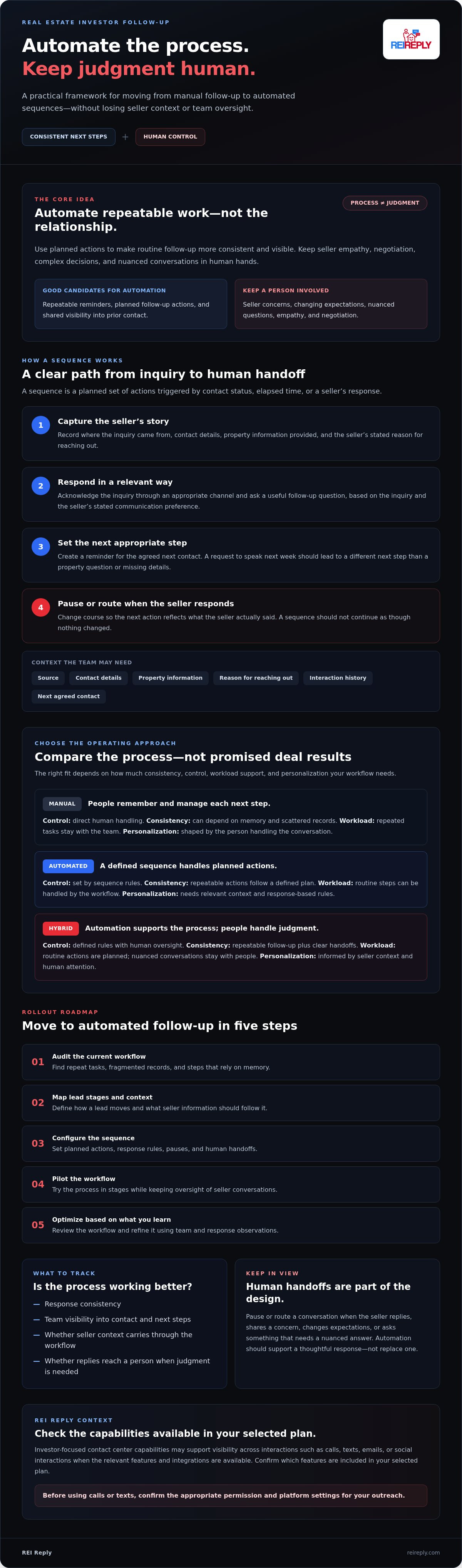
A sequence turns a seller inquiry into a defined workflow. It’s a planned set of actions triggered by a contact’s status, the time since the last interaction, or a response. The goal isn’t to send the same message to every lead. It’s to make the next appropriate step clear while keeping the seller’s context in view.
Imagine an owner submits an inquiry about selling a property. The record should capture where the inquiry came from, the owner’s contact details, the property information they provided, and their stated reason for reaching out. A sequence might acknowledge the inquiry through an appropriate channel, ask a relevant follow-up question, and create a reminder for the agreed next contact. If the owner replies, the sequence can pause or change course so the next step reflects what they actually said.
What belongs in a motivated-seller follow-up sequence?
Build around useful context, not message volume. An owner asking for a call next week needs a different next step from one who has a property question or hasn’t shared enough detail. Set actions according to the inquiry and the seller’s stated communication preference. Before using calls or texts, confirm the appropriate permission and platform settings for your outreach.
For example, a call may suit a seller who asked to speak by phone, while a written response may fit better if that’s how they reached out. If you’re considering call automation, this AI voice agent for real estate guide explains the topic. The National Association of REALTORS® also offers a technology survey for real estate professionals that can help readers explore how agents are making practical choices about technology.
Where do AI, CRM records, and human handoffs fit?
A contact record can help the team see interaction history across supported channels, such as calls, texts, emails, or social interactions, when the relevant features and integrations are available. AI-assisted qualification can gather details, summarize responses, or help identify a useful next step. It can’t guarantee that a seller is ready to transact.
Set a clear handoff rule. A complex question, negotiation, or sign that the seller’s circumstances have changed should go to a person who can use judgment and respond with empathy. Before migrating contacts, verify which CRM integrations, channels, AI capabilities, and handoff controls are included in the platform plan you’re evaluating. Investors comparing options can review REI Reply’s investor-focused platform and its contact-center capabilities.
Manual vs. automated follow-up: compare control, consistency, and seller experience
Automation can make follow-up more consistent, but it can’t make every message relevant by itself. Automate predictable steps, keep accurate seller and property context attached, and define when a person takes over. That’s the practical balance when switching from manual follow up to automated sequences.
| Approach | Process capabilities | What it doesn’t guarantee |
|---|---|---|
| Manual | A team member chooses the timing, channel, and message for each interaction. | Consistent timing or complete records if tasks depend on memory and separate tools. |
| Automated | Configured actions can follow defined triggers and repeat the same process reliably. | Seller readiness, a positive response, or a deal. Poor context can also produce irrelevant messages. |
| Hybrid | Automation handles routine steps, while people review replies and make judgment calls. | Good outcomes without clear rules, accurate contact records, and active oversight. |
These are workflow differences, not promises about business results. A sequence can send an acknowledgement or create a follow-up task according to your rules. It can’t ensure a seller is interested or that a property fits your criteria. Start with repetitive, predictable actions, then check whether each step still makes sense for the lead.
Can automated sequences still feel personal?
Yes, when personalization uses relevant facts rather than superficial message variations. Use the seller’s name only when it’s accurate, reflect the property details they shared, and refer to their stated reason for reaching out. A message about a requested callback is more relevant than a generic check-in that ignores the conversation.
Pause the sequence when the seller replies and a person needs to review the message, asks not to be contacted, or shares a change in circumstances that makes the planned follow-up inappropriate. Don’t assume AI can perfectly interpret intent. Human review helps preserve empathy and context when a scripted next step could miss the point.
When is a hybrid follow-up process the better choice?
Hybrid is a strong fit when routine coordination is predictable but seller conversations require judgment. Let automation acknowledge an inquiry, route a response, set reminders, or gather basic information. Keep negotiation, complex questions, and relationship-sensitive decisions with your team.
Use a simple escalation rule: if the seller replies with a question, concern, negotiation point, or unexpected detail, pause the sequence and assign a person to review it. If there’s no response, continue only with follow-up steps that match the contact’s context and communication preferences. This gives your team structure without forcing every seller into the same script.
How to automate follow-up sequences in five steps
Switching from manual follow up to automated sequences works best as a controlled migration, not a sudden system-wide change. Preserve existing seller context, test the new process, and expand only when handoffs and records are working as intended.
1. Audit the current process. Inventory lead sources, contact records, duplicate entries, and active conversations. Document each lead stage, the person responsible, the channel used, and any follow-up already promised. Flag consent, opt-out, and record-retention questions for appropriate review before moving contacts or starting outreach.
2. Map each next step. Turn the manual workflow into clear rules. For every action, record its trigger, owner, channel, and intended next step. For example, a callback promised for a particular day should have an owner and a reminder tied to the right contact record. Separate routine tasks from replies or decisions that need human judgment.
3. Configure the sequence. Start with repeatable actions such as acknowledgements, reminders, or routing a response to the right team member. Use relevant contact and property details, and define when a sequence pauses, stops, or escalates. Before launch, verify the platform’s supported data migration methods, CRM integrations, channel access, and handoff controls for the plan you’re considering.
4. Pilot with a limited group. Don’t route every new inquiry into a sequence on day one. Test representative scenarios first: a new inquiry, a seller who replies with a question, a request for later follow-up, and a contact who opts out. Have team members review message relevance, timing, record accuracy, and whether complex replies reach a person.
5. Optimize using process indicators. Track measures that show whether the workflow is functioning, not whether it guarantees a deal:
- Response time: How long it takes for the first appropriate response.
- Completion: Whether assigned sequence steps are completed or correctly paused.
- Qualified conversations: Whether useful seller discussions are identified and recorded.
- Opt-outs and handoff quality: Whether contact preferences are respected and human escalations include enough context.
Review the results with your team, fix unclear triggers or missing context, and adjust before expanding. That feedback loop keeps automation accountable to the seller experience and the way your team works. To explore a platform built for real estate investor communications, explore REI Reply and verify which features fit your migration plan.
How REI Reply can support the move to automated investor follow-up
Once you’ve mapped your process and identified which steps are safe to automate, choose a platform that supports your workflow rather than forcing you to rebuild it around generic sales tools. REI Reply is an AI-powered marketing and contact center platform built for real estate investors. Its capabilities include calls, texts, emails, and social interactions, offering a way to manage follow-up across supported channels. Feature access can vary by plan, so confirm what’s available before planning a migration.
For investors switching from manual follow up to automated sequences, the practical question is how well a platform preserves seller context and supports human oversight. REI Reply offers contact management and CRM integration capabilities. AI-assisted lead qualification and deal booking are also capabilities to check against the integrations and plan you intend to use. Treat these as evaluation points, not assumptions about what’s included or how every lead will be handled.
What to evaluate before choosing an automated platform
Test the workflow you actually plan to run. Confirm which channels are supported and available on your plan, whether contact history is visible to the team, and whether your CRM connects through a supported integration or migration method. Check how permission and opt-out information is handled, and ask how team members can monitor conversations, pause automation, or take over a seller interaction. A supported channel isn’t automatically included in every plan.
Use a real example from your process: a seller replies with a question after an initial message. Can the right team member see the prior interaction, understand the property context, and take over without losing the thread? If the answer depends on a feature or integration, verify it before committing to a migration plan.
How to keep people in control after the switch
Assign clear owners for automation. Decide who reviews replies involving negotiation, complex questions, or a change in the seller’s circumstances. Establish how the team will monitor sequence activity and review conversation samples, then use those reviews to catch irrelevant messages, missing context, or unclear handoffs. That oversight keeps the process accountable to real seller conversations.
REI Reply lists live human support and training among its offerings. Confirm the details and relevance to your team as part of your evaluation. The right fit depends on your workflow, required integrations, oversight needs, and readiness to manage handoffs. See how REI Reply fits your follow-up workflow and assess its capabilities against your migration criteria.
Make your next follow-up step more consistent
Switching from manual follow up to automated sequences doesn’t mean handing seller relationships over to software. Automate repeatable actions first, preserve contact history, and keep people responsible for negotiation, sensitive replies, and decisions that need context. A staged rollout lets you test handoffs and message relevance before expanding the workflow.
Measure whether the process is working by reviewing response time, completed follow-up, qualified conversations, opt-outs, and handoff quality. Those signals help your team spot gaps and improve visibility without confusing activity with guaranteed deal results.
REI Reply is built for real estate investors and supports AI-powered interactions across calls, texts, emails, and social channels. Confirm which capabilities are available with your selected plan. Live human support and training are listed offerings; verify current details as you assess fit, integrations, and team readiness.
Ready to explore an investor-focused option for your workflow? See how REI Reply can automate investor follow-up. Start with a clear plan, keep human judgment in the loop, and build a process your team can improve with confidence.
Frequently Asked Questions
How do I switch from manual follow-up to automated sequences?
Switch in stages by documenting your current lead stages, channels, owners, and follow-up commitments first. Then map repeatable actions to clear triggers, clean and transfer contact records, and pilot the workflow with human oversight. Review replies, opt-outs, handoffs, and process measures before expanding. This approach to switching from manual follow up to automated sequences helps you catch missing context or unclear steps while the number of leads in the new workflow is still manageable.
Will automated follow-up make my messages feel impersonal?
Not necessarily, if your messages reflect the seller’s contact and property context. Automation can keep routine timing consistent, but it shouldn’t send the same message regardless of what someone says. For example, pause a sequence when a seller replies with a question or shares a change in circumstances. Route replies that need interpretation, empathy, or negotiation to a person. Relevant details and thoughtful handoffs make automation more responsive, though not automatically more personal.
What should a real estate investor automate first?
Start with predictable tasks your team can define clearly, such as acknowledging an inquiry, assigning a lead, creating a follow-up reminder, or requesting basic information. Keep negotiation, sensitive seller concerns, and decisions that depend on context with a person. Choose a workflow that happens often enough to review but is limited enough for close monitoring. This gives you a practical test without putting every seller interaction into automation at once.
How do I move existing leads into automated sequences without losing their history?
Audit records before migration. Identify duplicate contacts, missing details, current lead status, and recent conversations, then preserve relevant notes and interaction history where your platform supports it. Test a small group of records and check that details remain accurate and sequence enrollment works as intended. Keep a manual follow-up process available during the transition so the team can continue handling active conversations if a record or handoff needs attention.
Can AI follow-up qualify motivated sellers automatically?
AI can help gather information and support initial qualification, but your team should define the criteria and review how they fit actual seller conversations. A system’s qualification output doesn’t guarantee that someone is ready to transact. Set escalation rules for strong interest, complex questions, uncertain responses, or information that doesn’t fit the expected path. This lets AI support the process while people retain responsibility for nuanced judgment.
How do I measure whether automated follow-up is working?
Track process measures such as time to first response, completed follow-up tasks, reply rates, opt-outs, and whether human handoffs reach the right person with useful context. Review qualification and deal progression separately, since outcomes can depend on factors beyond the sequence. Compare pilot results with your documented starting process. When you adjust the workflow, change one element at a time where practical so you can identify what needs improvement.
Should I automate every follow-up channel at once?
A phased rollout is usually easier to oversee. Start with the channels and actions your team can monitor reliably, then test how contact records, replies, and handoffs move through the workflow. Expand after the initial sequence handles responses and opt-outs as intended. Before adding another channel, confirm platform support, permissions, and plan availability. This keeps the change manageable and helps your team catch issues before they affect more conversations.


