
How to Handle SMS Opt-Out Requests Legally in 2026
What if the riskiest opt-out is the one your system doesn’t recognize? Knowing how to handle SMS opt-out requests legally means looking beyond “STOP.” Since April 2025, FCC rules require businesses to honor requests made through any reasonable means, including a phone call, email, or clear natural-language reply. The request must be processed within 10 business days, but prompt action helps prevent another unwanted text while a request is waiting to be handled.
It’s easy to see why teams feel exposed. A contact record in one CRM, a campaign in another tool, and a separate dialer can turn a simple “please stop texting me” into a missed handoff. A keyword-only process also won’t reliably catch every clear request.
This guide lays out a practical, reviewable approach: recognize standard and less-standard revocations, stop future messages consistently across relevant systems, and document what happened and when. You’ll also learn how to review the process so marketing and follow-up workflows don’t work against a suppression decision. For real estate investors managing leads across multiple channels, the goal is straightforward: one clear request, one coordinated response, and a record your team can review.
Key Takeaways
- Learn how to handle SMS opt-out requests legally by treating clear requests as signals to review and act, not just keyword matches.
- Map every lead source, CRM, messaging tool, and automation that could send a text so you know where to apply suppression decisions.
- Use a defined workflow to record the request, stop applicable messages, verify the change, and retain a reviewable record.
- Compare centralized suppression records with manual updates to identify handoff gaps before they lead to another unwanted message.
- Audit records, automations, and test contacts regularly, and confirm your process against current federal and state requirements.
How SMS opt-out rules work under U.S. law
An SMS opt-out is a person’s request to revoke permission for covered text messages. It’s more than a keyword or a change to a contact’s preferences. It’s an instruction to stop the messages covered by that request, and teams need a reliable way to act on it.
The federal framework includes the Telephone Consumer Protection Act of 1991 (TCPA) and related Federal Communications Commission (FCC) rules. Text messages can fall under TCPA requirements, but which rules apply depends on the facts. Consent, message purpose, the technology used to send the text, and the recipient’s circumstances may all matter. Don’t assume every text has identical requirements or that a particular message category is automatically exempt.
Which rules may apply to marketing texts?
Marketing texts often raise consent and revocation questions under federal law. Other message types may be treated differently, but their purpose alone doesn’t establish that no requirements apply. Review the campaign, how messages are sent, and the consent records together. State laws and other applicable obligations may add requirements, so ask qualified U.S. counsel to check current federal and state rules for your specific program.
What does revoking consent mean in practice?
Under the FCC’s “any reasonable means” standard, a request may come through a channel or wording beyond a prescribed reply keyword. A person might reply “STOP,” write “please don’t text me,” or contact the business another reasonable way. For covered requests, the current federal processing window is 10 business days, though prompt action is the stronger operational standard. Confirm applicability, exceptions, and any stricter obligations with counsel before relying on a timeline.
Once a message clearly asks you to stop, treat it as a suppression instruction, not a negotiation about how often to send texts. A request to reduce frequency may mean something different, so assess the wording and context rather than recoding an explicit stop request as a preference change. Record what was received, when, and how the business responded. For real estate investors, make that record accessible to the people and systems managing lead follow-up.
Prompt suppression helps prevent a clear request from becoming another unwanted message, while reliable records show what your team did and when. This is general educational information, not legal advice for a specific campaign, dispute, or recipient. If you’re deciding how to handle SMS opt-out requests legally in a particular situation, consult qualified counsel.
Which replies count as SMS opt-out requests?
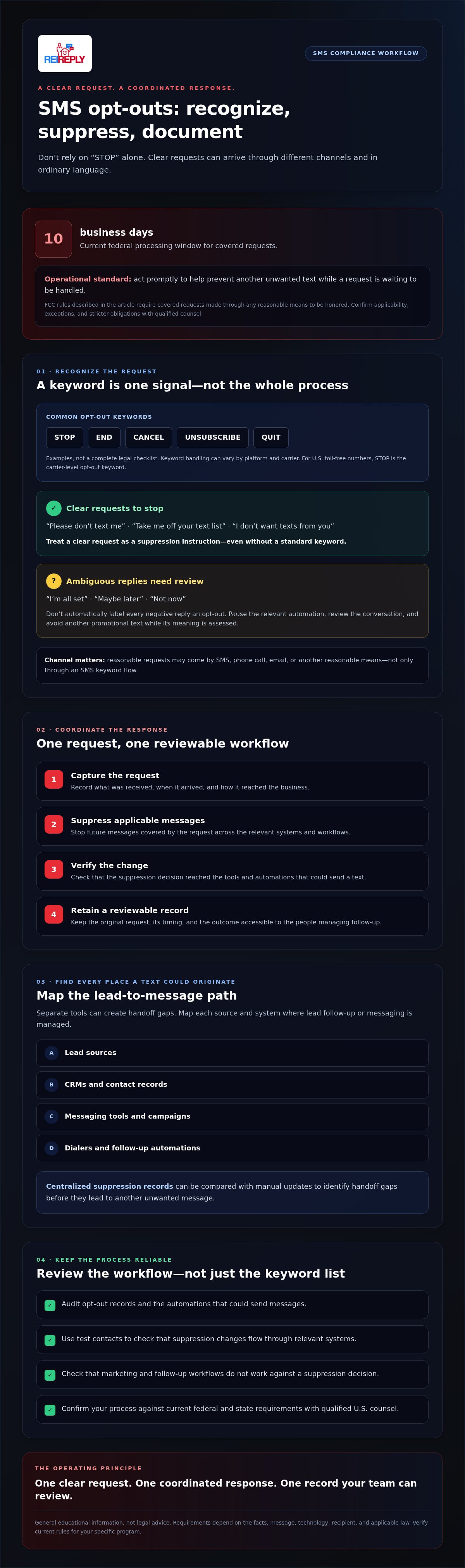
“STOP” is the familiar signal, but it isn’t the only wording that deserves attention. Commonly supported opt-out keywords include STOP, END, CANCEL, UNSUBSCRIBE, and QUIT. These are useful examples, not a complete legal checklist. Keyword handling can also vary by platform and carrier. For U.S. toll-free numbers, STOP is the carrier-level opt-out keyword, so verify how your messaging setup handles other replies.
A clear request to stop texting is an opt-out; an ordinary reply that doesn’t ask to stop is not. “Do not text me,” “take me off your text list,” and “I don’t want texts from you” plainly signal a desire to end texts. Don’t dismiss them because they lack a standard command. The FCC’s guidelines on stopping unwanted texts provide consumer-facing context. Ask qualified counsel to verify how current rules apply to your program.
Do requests have to use STOP?
No. The absence of a recognized keyword doesn’t automatically make a clear request irrelevant. Under the “any reasonable means” standard described in current FCC guidance, revocation can be expressed in natural language and may arrive outside the SMS reply flow. That doesn’t mean every platform or carrier interprets every phrase identically. Configure keyword recognition, but don’t make it your only review path. “Please stop sending me property alerts” communicates something different from “not interested in this house,” and the distinction matters.
How should teams handle unclear or channel-specific requests?
Some replies are ambiguous: “I’m all set,” “maybe later,” or “not now.” Don’t treat every negative response as a confirmed opt-out, but don’t let uncertainty trigger another promotional text while someone decides what it means. Pause the relevant automation, review the conversation, and use a non-promotional clarification only if appropriate under your policies and applicable rules. If the message clearly asks to stop, suppress texts rather than seeking confirmation.
Keep a reviewable record of the original message, the time received, the sending number, and the outcome. If someone says “stop texting this number,” don’t assume without review that they’ve withdrawn permission for every distinct communication channel. Apply the request to the relevant channel and campaign, and check current rules and internal policy before extending it further.
For real estate investors, consistent handling depends on knowing which tools can send follow-ups. Teams comparing multichannel contact workflows can explore REI Reply’s platform, then verify directly which records and suppression actions are supported before relying on any system for opt-out handling. The business must configure and monitor its process.
What should happen immediately after an opt-out?
Move from receiving a request to verifying suppression without letting a follow-up campaign slip through. For covered requests, the current federal processing window is 10 business days, but prompt action is the safer operational standard. Confirm the rule’s application, any exceptions, and stricter state or other requirements with qualified U.S. counsel.
A practical opt-out processing sequence
- Capture the request. Preserve the original message and record when it arrived, the sender’s number, the channel, the campaign, and the system that received it. If the request came by phone or another channel, document what was communicated and who recorded it.
- Stop applicable SMS activity. Apply suppression to the relevant contact and SMS campaigns. Check queued, scheduled, and automated messages too. A contact marked as opted out in one interface may still be eligible for a send triggered elsewhere.
- Check connected systems. Review the CRM, messaging tools, dialer, lead-source integrations, and any workflow that can launch a text. Confirm the suppression status reached each relevant system instead of assuming an update propagated automatically.
- Verify and document. Use a controlled test or system review to confirm that the contact is excluded from applicable sends. Record what you checked, when suppression took effect, and any issue that needed correction. Avoid sending a test message to the person who opted out.
The operational goal is to prevent another covered text after suppression takes effect. That takes more than changing one contact field. Trace the request through every connected sending path and retain evidence of the result. This is the practical core of how to handle SMS opt-out requests legally, while recognizing that system configuration alone doesn’t determine legal compliance.
Can you send a confirmation text?
A single, neutral confirmation may be permitted after an opt-out under current FCC guidance. Its purpose is to acknowledge the request, not restart the conversation or promote an offer. Keep it brief and free of marketing content. For example: “You’re unsubscribed and won’t receive further marketing texts.” Don’t add a property pitch, a link to an offer, or a prompt to reconsider.
Send a confirmation only when the applicable rules and context allow it. Current guidance permits one confirmation, with prompt delivery recommended; a five-minute target is an operational recommendation, not a substitute for checking the governing rule. If counsel, the relevant rule, or the circumstances advise against a confirmation, send nothing. Then verify suppression independently. The confirmation itself doesn’t prove that scheduled messages and connected automations have stopped.
How real estate investors can prevent opt-outs from being missed
A suppression decision can fail at a handoff. A lead enters through a property inquiry form, moves into a CRM, then triggers a text from a separate messaging tool or dialer. To prevent a later send, map every point where contact data enters, changes, or launches a message. Include imported leads, CRM tasks, scheduled sequences, dialer-connected texts, third-party integrations, and any automation that can send independently.
Where can a missed opt-out re-enter the workflow?
List each system, whether it can send messages, and the person responsible for its settings. Deleting a contact isn’t a reliable suppression method: another tool may still hold the number, while deletion can remove records needed to understand and review the request. Keep an appropriate suppression record and follow counsel’s guidance on retention.
Coordinated communication matters beyond texting, too. A clear view of channel handoffs can help teams assess related workflows, including the considerations in this AI voice agent guide for real estate. Don’t assume an SMS opt-out automatically revokes permission for every separate channel; define how your policy handles that distinction.
| Approach | How it works | Risk to manage |
|---|---|---|
| Centralized suppression record | Teams consult a shared status and apply it across identified sending systems. | Confirm integrations actually receive and honor updates. |
| Disconnected manual updates | Staff change records separately in each tool. | A missed update can leave a sending path active. |
What should a suppression policy document?
Name an owner for intake and review, assign responsibility for updating each system, and specify who handles unclear cases. If automation can’t confidently classify a reply, route it for human review and pause promotional texts from the relevant workflow while it’s assessed. Set access controls so only designated people can change suppression status, and establish a clear escalation path when a tool or integration fails.
Document the systems tested, the test method, the schedule for repeat checks, and the evidence retained, subject to counsel’s retention guidance. Test representative paths, such as a new imported lead and a scheduled follow-up, to confirm suppression prevents sends. For broader workflow planning, see this guide to an automated lead follow-up system.
Platforms can support coordinated contact management, but businesses still need to configure, monitor, and validate their own processes. Review how your communication workflows connect with REI Reply’s platform, and verify specific opt-out and suppression capabilities before relying on them.
How to audit your SMS opt-out process and improve it
A process that worked last quarter can break after a new integration, campaign, or permission change. Audit the full path: request intake, contact records, suppression decisions, and every system that can send a text. The goal is to find a failure before it reaches a contact. For real estate investors, include lead sources, CRM workflows, messaging tools, dialers, and connected automations in the review.
How can you test whether suppression works?
Use controlled test records, not real opted-out contacts. Check whether sample requests are captured, applicable campaigns exclude the test record, queued texts are stopped, and connected systems reflect the suppression status. Record the test date, expected result, actual result, issue owner, and corrective action. Re-test after integrations, workflows, message templates, or system permissions change.
- Records: Confirm the request and relevant contact details are reviewable, with access limited to appropriate staff.
- Automations: Check active sequences, scheduled sends, imports, and any tool that can initiate SMS independently.
- Failures: Assign an owner, document the fix, and repeat the test to confirm the issue is resolved.
Make testing repeatable. Set a review schedule, retain results according to counsel’s guidance, and record which systems and sending paths were included. A checklist turns “we think suppression works” into evidence your team can inspect.
When should you involve counsel or review software?
Ask qualified U.S. counsel about campaign-specific consent questions, disputed requests, state-law issues, or legal notices. This guide offers general information, not advice for a particular campaign. Review software separately: ask what suppression controls are documented, how integrations behave, who can change records, and what history can be reviewed. Verify each capability directly before relying on it.
Software can support a process, but the business remains responsible for configuring, monitoring, and validating its own workflows. REI Reply is a multichannel contact-management platform for real estate investors; don’t assume a particular opt-out control or audit feature without confirming it. To see how its contact-management approach may fit your communication workflow, explore REI Reply.
Run this audit consistently. That’s how to handle SMS opt-out requests legally as an operational discipline: test the records, check every sending path, assign clear ownership, and close the loop when a check fails.
Build an opt-out process your team can trust
Effective SMS opt-out handling takes more than recognizing “STOP.” Teams need to take clear requests seriously, pause applicable texts, and check that suppression reaches every connected sending path. A consistent record of the request and your response makes the process easier to review and improve.
Knowing how to handle SMS opt-out requests legally also means testing what happens after the system changes. New integrations, workflows, or permissions can create gaps, so keep ownership clear and verify the process regularly. Consult qualified U.S. counsel about current rules and how they apply to your campaigns.
For real estate investors coordinating calls, texts, email, and social interactions, REI Reply offers a multichannel platform with automatic contact management and CRM integration. Confirm which specific opt-out and suppression capabilities are supported before relying on them. Explore REI Reply’s platform for real estate investors and see whether it fits your workflow.
With clear procedures, regular checks, and the right systems, your team can follow up with confidence while respecting each person’s decision.
Frequently Asked Questions
Does a text message have to say STOP to count as an opt-out?
No. STOP is a standard opt-out keyword, but a clear request such as “please don’t text me” may also count. Current FCC rules recognize requests made through any reasonable means, so a business shouldn’t ignore plain-language wording just because it doesn’t match a configured keyword. Treat clear stop requests as suppression instructions, and check with qualified U.S. counsel about how the rules apply to your messaging program.
How quickly must a business honor an SMS opt-out request?
For covered requests, the current federal processing window is 10 business days from receipt. Acting sooner is the stronger operational practice: stop applicable texts promptly, check scheduled sends, and verify relevant systems reflect the request. Other rules or circumstances may affect the deadline, so don’t treat 10 business days as a universal allowance. Have qualified U.S. counsel confirm current federal requirements and any stricter obligations that apply to your campaigns.
Can I send one text confirming that someone opted out?
A single confirmation may be allowed, but keep it strictly neutral and limited to acknowledging the opt-out. Don’t include a promotion, property listing, or invitation to reconsider. FCC guidance allows one confirmation message; prompt delivery, often within five minutes, is recommended. Confirm current requirements and the circumstances before sending. If the applicable rule, the context, or counsel advises against a confirmation, don’t send one.
Does opting out of texts also stop calls and emails?
Not automatically in every situation. A request to stop texts should at least trigger suppression of applicable SMS messages, but don’t assume it also revokes permission for calls, emails, or social messages. The scope of a request and the rules that apply can depend on its wording and context. Record what the person asked to stop, apply it carefully, and get legal guidance when the request could reasonably cover other channels.
Can I text a real estate lead again after they opt out?
Don’t send further covered marketing texts after a person has opted out. Pause relevant campaigns and scheduled messages, then verify that connected systems won’t send another text. A later change in the contact record or a new lead event shouldn’t silently undo suppression. Before considering any exception or relying on new consent, consult qualified U.S. counsel and document the basis for resuming messages. A person’s interest in a property doesn’t erase a clear opt-out.
What records should I keep after someone opts out of SMS?
Keep the original request, the date and time received, the sender’s number, the channel and campaign involved, and the system that received it. Document when suppression was applied, which relevant systems were checked, and any corrective action if a message path remained active. Limit access to appropriate staff and follow qualified counsel’s advice on retention. These records help your team review how to handle SMS opt-out requests legally and consistently.
What if someone replies with an unclear request to stop texting?
Pause promotional automation tied to the conversation while a designated person reviews the wording and context. If the reply could reasonably mean “stop texting me,” take the conservative route and suppress applicable SMS rather than sending another promotion to clarify. Preserve the original message and record the review outcome. For genuinely ambiguous cases, use a careful escalation process and seek counsel when the interpretation could create legal risk.


