
How to Avoid TCPA Lawsuits When Texting Sellers: A 2026 Guide
A seller’s phone number in your CRM isn’t permission to text it. If you’re asking how to avoid TCPA lawsuits when texting sellers, start with the process behind the message, not a clever opener or a faster dialer. Marketing texts may require prior express written consent. A wrong number, purchased data, or missed opt-out can turn routine follow-up into a serious risk.
That uncertainty is real. You need to know who agreed to receive marketing texts, what they agreed to, and whether they’ve since asked you to stop. The National Do Not Call Registry also applies to text messages, and state rules may add requirements. Automation can help organize follow-up, but it doesn’t remove your legal responsibility.
This guide covers the key decisions to review before texting, from permission and number accuracy to opt-outs, suppression, and response handling. You’ll learn how to build a documented workflow, keep contact history organized, and assess whether a platform supports your reviewed policies. No checklist or tool guarantees protection. A consistent, evidence-backed process gives your team a stronger foundation, while qualified counsel confirms how current federal and state laws apply to your campaigns.
Key Takeaways
- Learn how to avoid TCPA lawsuits when texting sellers by including permission, message purpose, sending method, and applicable jurisdictions in your pre-send review.
- Don’t treat a phone number from purchased, skip-traced, or aged data as proof that its owner agreed to receive marketing texts.
- Use a documented workflow to define each campaign, review records before sending, and capture replies and opt-out requests.
- Compare manual and automated follow-up for consistency, oversight, and record visibility before choosing how to manage outreach.
- Use technology to support your reviewed policies, not to decide whether a contact is legally eligible for a text or to guarantee protection from lawsuits.
Why texting real estate sellers can create TCPA lawsuit risk
A text asking a homeowner whether they’d consider selling isn’t just a casual conversation. It’s outreach intended to generate business, so treat it as marketing and review permission and delivery method before sending. Risk often starts earlier: a number enters a database, but the team can’t show who supplied it, whether the person agreed to marketing texts, or what happened after they replied.
The Telephone Consumer Protection Act (TCPA) is a U.S. federal law that restricts certain calls and texts, including some telemarketing communications, based on factors such as how a message is sent and who receives it. The Telephone Consumer Protection Act of 1991 (TCPA) offers a general overview. It isn’t a substitute for reviewing current federal rules and applicable state laws with qualified U.S. counsel. Compliance procedures can reduce risk, but no checklist, platform, or wording can guarantee that a business won’t face a claim or lawsuit.
What does the TCPA regulate when you text a seller?
Federal rules may require prior express written consent for marketing texts, depending on the message and circumstances. Texts to numbers on the National Do Not Call Registry can raise additional concerns. An operational update or a direct response to an inquiry may be analyzed differently from a solicitation, but calling a message “informational” doesn’t settle the question. Content, purpose, sending technology, recipient status, and other facts can matter. Have counsel review the rules that apply to your campaigns.
Why real estate investor outreach has extra moving parts
Seller outreach can pass through several hands. A number is collected, matched to a property, imported from a data source, assigned to a campaign, and contacted by a person or an automated system. Replies, follow-ups, and opt-out requests then need to reach everyone involved. A vendor’s record may not match the investor’s, or a contact’s status may not update across systems. That gap can lead to another message going out after someone has asked not to be contacted.
Build a consistent handoff from lead source to first message and every later touch. Record where the contact came from, what permission evidence exists, which campaign applies, and how responses are handled. These records support a more disciplined process, but they don’t prove legal compliance on their own. For practical ideas on organizing follow-up across a team, see this automated lead follow-up system guide.
So, how to avoid TCPA lawsuits when texting sellers? Treat each campaign as a documented decision, not a bulk-send task. Review the audience, message purpose, technology, and jurisdictions before launch. Then make sure your people and systems follow the same reviewed process.
Consent, automation, and opt-outs: the TCPA questions to answer first
A phone number attached to a property record isn’t proof that its current user agreed to receive your marketing texts. Permission depends on more than possession of the data. Message purpose, how it’s sent, who receives it, and the consent evidence available can all affect the legal analysis. A seller’s earlier inquiry may be relevant, but don’t assume it grants unlimited permission for future campaigns.
Does a seller inquiry or existing relationship automatically allow marketing texts?
Not automatically. Before relying on an inquiry or prior interaction, have counsel review what the person agreed to, which business or sender was identified, what messages the agreement covered, and whether the proposed text fits that scope. Check when permission was obtained and whether the number may have been reassigned. Consent is tied to the person, not simply the phone number. Don’t treat disputed or changing interpretations as a blanket exception.
For a campaign-specific starting point, review the FCC rules on robocalls and texts, then ask qualified U.S. counsel how federal and applicable state requirements fit your audience, message, and sending method.
How should investors handle STOP messages and other revocations?
Build opt-outs into the workflow, not just the texting software. Capture requests made by text, phone, email, or to a team member. Then make sure the relevant contact status is shared across the people and systems involved. The stated timeframe for honoring opt-out requests is 10 business days, but teams should act promptly and have counsel confirm current deadlines and requirements.
FCC revocation rules are changing. The September 2026 order permits clearly disclosed exclusive revocation methods in specified circumstances. If no method is designated, reasonable revocation methods must be honored. Its category-specific approach applies to informational messages, not telemarketing or promotional communications. Confirm the order’s effective date and how it applies to your campaign before relying on a particular method. Don’t assume a STOP keyword is the only valid request unless counsel has reviewed your disclosures and process. Ask counsel to verify whether and how to send a confirmation, too.
- Record the request: Preserve the channel, date, contact, and language used.
- Stop future marketing: Ensure the status reaches every team member and workflow that could send another text.
- Check before restarting: Don’t resume marketing based on a new number or fresh data alone. Review the permission basis with counsel.
For how to avoid TCPA lawsuits when texting sellers, make consent review and opt-out handling operational checkpoints. Then assess whether your communication platform supports the policies your counsel has reviewed. You can explore REI Reply’s communication platform as one option for organizing contact management and follow-up. Verify any specific controls you need before relying on them.
Common seller-texting practices that can increase lawsuit exposure
Risk often comes from assumptions built into a workflow. A number looks current, a script includes “STOP,” and an automated campaign is ready to launch. None of those facts alone establishes permission or makes a message legally safe. Use this comparison to identify what needs review before sending.
| Risky assumption | Why it may fail | Safer question to resolve before sending |
|---|---|---|
| “We have the number, so we can text it.” | A property record or phone number doesn’t show that the current user agreed to receive this marketing message. | What evidence supports permission for this sender, purpose, and method? |
| “The data was purchased or skip-traced, so it’s ready.” | Data access doesn’t establish consent, and the number may be outdated or reassigned. | Who provided the data, when was it sourced, and what screening and legal review support this use? |
| “The message says STOP, so we’re covered.” | An opt-out instruction can help recipients express a preference, but it doesn’t establish prior permission or correct earlier contact. | Can every opt-out, including one received outside SMS, reach the people and systems sending follow-ups? |
| “Automation makes outreach consistent, so it’s safe.” | Automation can repeat an error at scale if inputs, contact status, or suppression processes are inaccurate. | What checks prevent an unreviewed or ineligible record from entering a campaign? |
Can purchased or skip-traced seller data be texted automatically?
Not based on the data source alone. Skip tracing may help locate contact information, but it doesn’t verify consent or prove that the listed number still belongs to the intended seller. Before using purchased, skipped, or aged records, document the provider, source date, screening steps, and campaign use reviewed by counsel. The FCC’s rules on unwanted robocalls and texts are a useful federal reference, but they don’t replace campaign-specific legal advice.
Build in a way to flag wrong-number replies and update the contact record. Consent belongs to a person, not a number, so reassignment can make old assumptions unreliable. Refreshing information and checking applicable screening requirements can support a stronger process, but neither step proves permission by itself.
Do scripts, disclaimers, or an opt-out line eliminate TCPA risk?
No script can substitute for an appropriate permission and suppression process. An opt-out instruction is useful only if requests are captured and acted on across the campaign. High-volume automation isn’t automatically a violation, but it raises the stakes of stale data, missed replies, and inconsistent records. For how to avoid TCPA lawsuits when texting sellers, review the source, permission basis, message, sending method, and response workflow together. Ask qualified counsel to review specific scripts and campaign practices. Don’t assume any wording or message frequency is universally safe.
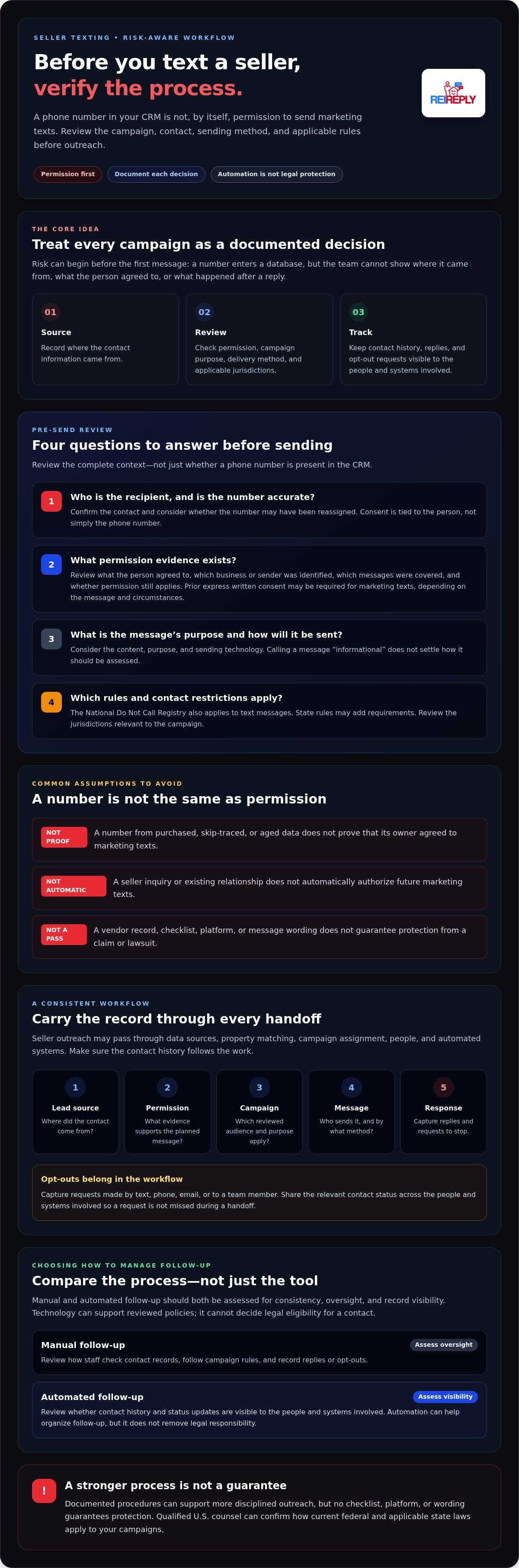
A pre-send checklist for texting real estate sellers more carefully
A repeatable pre-send review turns good intentions into a process your team can follow. Before launching or changing a campaign, document its purpose, sending method, intended audience, and the jurisdictions involved. Have qualified U.S. counsel review the planned approach, especially if the data source, technology, message purpose, or applicable law changes.
- 1. Define the campaign. Record what the message is meant to do, who will receive it, which business or sender will be identified, and whether follow-up is planned.
- 2. Check the permission basis. Confirm what evidence exists for each contact and whether it covers the proposed message and sending method. Flag gaps for review instead of treating a populated record as approval.
- 3. Screen the audience. Check contact details, applicable screening requirements, prior replies, and suppression records. Investigate uncertain or potentially reassigned numbers before including them.
- 4. Send under reviewed rules. Use the approved message and workflow. Make sure staff and automation follow the same campaign limits and can stop if a record or response raises a concern.
- 5. Capture and route responses. Retain replies and opt-out requests, update the contact status, and ensure suppression applies across staff, campaigns, and communication tools.
What records should an investor keep before and after texting?
Keep enough context to reconstruct the decision: contact source and source date, consent evidence, message purpose, relevant limitations, and the campaign or sending method used. Preserve outgoing messages, delivery outcomes, replies, opt-out requests, and the action taken to suppress further contact. Work with counsel to set a written retention policy that fits your legal obligations and business needs. Don’t assume one retention period works for every campaign or jurisdiction.
How can teams test a campaign before it scales?
Start with a small, counsel-reviewed test group. Confirm the records match the intended audience, replies reach the right people, and opt-outs are reflected across connected workflows. Test a wrong-number response and an opt-out before enabling automated follow-up. Assign a person who can pause the campaign and escalate complaints or unclear permission records. A test can expose process failures, but it can’t certify legal compliance.
For how to avoid TCPA lawsuits when texting sellers, make the review repeatable, assign ownership, and keep evidence of what the team checked. If you’re assessing tools for organized contact management and follow-up, explore REI Reply’s communication platform and verify that its current capabilities support the workflows your counsel has reviewed.
Use texting technology without treating automation as legal protection
Manual texting gives a person direct control over each send, but it can leave contact history scattered across inboxes, spreadsheets, and individual judgment. Automation can apply a consistent workflow and make follow-up easier to coordinate. It can also repeat a bad decision quickly if a record is inaccurate or the system doesn’t reflect a stop request. Neither method determines whether a seller can legally receive a message.
| Consideration | Manual follow-up | Automated follow-up |
|---|---|---|
| Consistency | Depends on each person following the reviewed process. | Can apply configured steps consistently, if the inputs and rules are correct. |
| Oversight | A person may spot an unclear record before sending, but checks can be missed. | Requires clear ownership, review, and a way to pause a workflow. |
| Record visibility | Contact history may be spread across individual tools. | May centralize activity, but confirm what the system actually records and lets you export. |
| Failure risk | Human error or inconsistent handoffs. | Incorrect settings or stale data can repeat across a campaign. |
Software can support a documented process. It can’t establish consent from incomplete data or replace legal review. Evaluate technology against policies approved for your campaigns, not a broad “compliance” label.
What should investors verify in an SMS platform?
Ask the provider to demonstrate how the system supports documented contact history, controlled follow-up, and visible opt-out handling. Confirm how suppression works across users and campaigns, what permissions different users have, and whether records can be exported for review. Verify each capability directly. Don’t assume it’s available because a platform supports SMS or automation.
When should you pause a campaign and get legal advice?
Pause and escalate uncertain consent, repeated wrong numbers, complaints, or unclear vendor data provenance. Bring in qualified counsel before changing outreach technology, targeting, or message purpose. If you coordinate calls and texts, review the proposed workflow as a whole. This AI voice agent guide for real estate can help you assess multichannel operations.
REI Reply provides an AI-powered platform for contact management and follow-up across SMS and other communication channels. Treat it as an operational tool, not legal protection, and verify any specific controls you need before relying on them. As you evaluate your process, consider how coordinated multichannel follow-up fits your counsel-reviewed policies.
How to avoid TCPA lawsuits when texting sellers: make follow-up more deliberate
Building a safer texting process starts before the first message. Confirm the permission basis, review the campaign’s purpose and sending method, and check that your team can capture opt-outs and keep contact records consistent. Purchased data, scripts, and automation don’t replace those decisions.
That’s the practical answer to how to avoid TCPA lawsuits when texting sellers: document your process, have qualified counsel review it against current federal and state requirements, and revisit it when your data sources, technology, or campaigns change. These steps can reduce risk, but they can’t guarantee that a claim or lawsuit won’t arise.
Technology can help teams coordinate follow-up across channels. REI Reply is an AI-powered contact center and marketing platform built for real estate investors, with support for SMS, voice, email, and social interactions. Live human support and training are also available as listed offerings. Assess whether the platform’s current capabilities fit the workflows your counsel has reviewed.
Explore REI Reply for organized, AI-powered investor follow-up. Build a process your team can understand, document, and improve with confidence.
Frequently Asked Questions
Can real estate investors text sellers without consent?
Sometimes, but don’t assume an unsolicited marketing text is allowed just because you have the seller’s number. Covered marketing texts may require prior express written consent, and the rules can depend on the message, sending technology, recipient, and circumstances. Do Not Call requirements and state laws may also apply. Have qualified U.S. counsel review the campaign before sending, especially if you’re relying on an exception or an existing interaction.
Does the TCPA apply to text messages?
Yes. The TCPA and related rules can apply to text messages, including certain marketing texts and messages sent using regulated technology. Whether a particular text creates legal risk depends on factors such as its purpose, how it was sent, the recipient, and the consent record. National Do Not Call Registry requirements also apply to text messages. Review current federal and state requirements with qualified counsel before launching a campaign.
Can I text a seller whose number came from skip tracing?
Not based on skip-traced data alone. Finding a number doesn’t establish that its current user agreed to receive your marketing text, or that the number still belongs to the seller. Record the data provider and source date, check the number and any available screening information, and document the permission basis for the campaign. Ask counsel to review the proposed use. A data match is not proof of consent.
Does sending STOP in a text protect my real estate business?
No. Including a STOP instruction can give recipients a clear way to opt out, but it doesn’t create permission for the original message or erase concerns about earlier contact. Your process should capture opt-out requests and prevent future marketing texts where required. Requests may arrive through other channels or reach another team member. Confirm current revocation rules, permitted methods, confirmation practices, and handling timelines with qualified counsel.
Can automated texting lead to a TCPA lawsuit?
Yes. Automation can send messages that prompt a claim if the campaign lacks an appropriate permission basis, uses inaccurate records, or fails to reflect an opt-out. Automation isn’t itself proof of a violation, but it can repeat a workflow error across multiple contacts. Review the audience, message purpose, sending method, and suppression process before launch. Assign someone to monitor responses and pause the campaign if records or handling appear unreliable.
Does an existing business relationship let me text a property owner?
Not automatically. A prior inquiry or relationship shouldn’t be treated as unlimited, permanent permission for marketing texts. Review what the person agreed to, which sender was identified, the purpose and scope of the permission, and when it was given. Also consider whether the phone number may have changed owners. Because legal interpretations and state requirements can vary, ask qualified counsel to assess the specific campaign before relying on a relationship.
How can I reduce TCPA risk when texting motivated sellers?
To understand how to avoid TCPA lawsuits when texting sellers, build a documented pre-send process: define the campaign, review permission, screen records, follow approved messaging practices, and capture replies and opt-outs. Keep contact history organized across staff and tools, and have counsel review the workflow under applicable federal and state law. These steps can reduce risk, but no checklist or technology guarantees that a claim or lawsuit won’t arise.


