
CRM for Real Estate Wholesalers: Built for Deal Flow
What if the seller lead you lose isn’t a bad lead, but a follow-up buried in the wrong tool? A crm for real estate wholesalers should do more than store contact details. It should help you track each seller conversation from first contact through qualification and disposition. When calls, texts, emails, and next steps are scattered across apps, even a promising lead can stall. A generic CRM may also fail to reflect how a wholesale opportunity moves from inquiry to contract.
You need a workflow that keeps seller activity visible and makes consistent follow-up easier as lead volume grows. This guide shows you how to evaluate a wholesaler-focused CRM, map it to your seller acquisition process, and assess how REI Reply fits your operation. You’ll learn which workflow capabilities matter, how to organize leads around deal progression, and how a connected platform can reduce fragmented admin. REI Reply brings together contact management and conversations across calls, texts, emails, and social media, with CRM integration and AI tools for real estate investors. The goal is to keep conversations and next steps in view, so your team can manage deal flow with greater control.
Key Takeaways
- Build your CRM workflow around seller progress, with clear stages, ownership, and next steps.
- Choose a crm for real estate wholesalers that captures lead sources, qualification notes, reminders, and contact history.
- Compare standalone CRMs with unified contact platforms by weighing setup, workflow coverage, and visibility across communication channels.
- Map your lead journey and handoffs before evaluating software to keep implementation aligned with how your team works.
- See how REI Reply combines multi-channel contact management, AI tools, and CRM integration to support investor workflows.
Why a CRM for real estate wholesalers must follow the seller lead
A seller inquiry is only the start of the work. You need to know where it came from, what the owner shared about the property, what your team has already discussed, and what should happen next. A CRM for real estate wholesalers brings those details into a working record, connecting seller information, conversations, tasks, and deal stages. It turns a contact list into an acquisition pipeline your team can act on.
A wholesaler CRM organizes seller records, conversation history, follow-up tasks, and deal stages so each lead has a clear status and next step. A name and phone number alone can’t show whether the seller has been qualified, whether someone promised to call back, or whether the opportunity belongs in active follow-up or long-term nurture.
What makes wholesaler CRM workflows different?
Real estate wholesaling revolves around seller acquisition and property-specific conversations. As Wholesaling in real estate describes, the process differs from general wholesaling because it concerns a real estate transaction and the contractual interest connected to a property. That context should shape how you organize leads.
A generic sales pipeline might track prospects, proposals, and customers. A wholesaler’s acquisition pipeline needs to capture lead source, property context, seller motivation, qualification details, and the status of the next follow-up. For example, a seller who needs time before deciding may belong in nurture, while a qualified opportunity may need a scheduled conversation or a contract-related next step. Record the context behind each move, not just the stage label.
Where disconnected tools create operational drag
When contact details live in one system, calls and texts in another, and reminders in a personal calendar, the team has to piece the story together manually. That creates repeated data entry and makes it harder to review the full conversation before reaching back out. The result is friction at the point where continuity matters most: the next seller interaction.
Ownership can get muddy, too. If a task has no clear assignee or due date, each team member may assume someone else is handling the follow-up. Give every active lead a responsible owner and a specific next action. That simple discipline makes handoffs easier to understand and review.
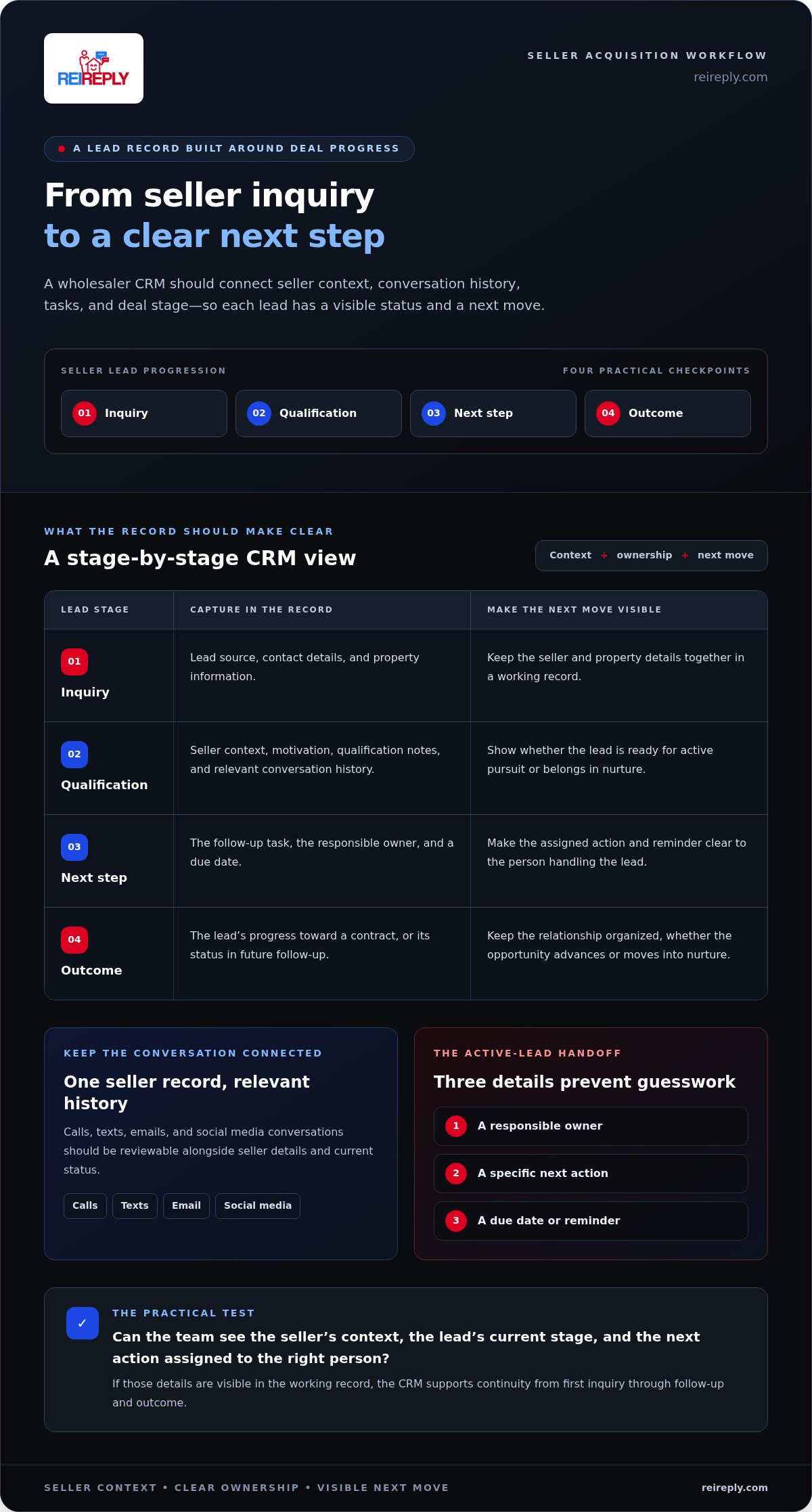
- Inquiry: Record the source, contact details, and property information.
- Qualification: Capture seller context and decide whether the lead is ready for active pursuit.
- Next step: Assign the follow-up, owner, and due date, or move the lead into nurture.
- Outcome: Track progress toward a contract or keep the relationship organized for future follow-up.
For a broader look at connecting automation to wholesale workflows, the automated wholesale real estate playbook explores how technology can support consistent operations. The foundation is clear: each lead needs context, ownership, and a visible next move.
Which CRM capabilities matter most for real estate wholesalers?
The best system isn’t the one with the longest feature list. It’s the one that makes the next seller interaction clear. For a crm for real estate wholesalers, start with the essentials: a usable contact record, lead source, qualification notes, reminders, and stages that show where each opportunity stands. Then assess how well it supports your team’s communication and handoffs.
Quotable checklist: A CRM is useful when it captures seller context, shows pipeline status, and makes the next action visible to the right person. Use that test to distinguish capabilities your workflow depends on from automation you may add later.
Contact records, lead stages, and task visibility
Each seller record should bring together key details: contact information, property context, where the lead came from, qualification notes, and interaction history. That gives anyone picking up the conversation a working understanding of what’s happened, rather than a bare name or scattered notes. Keep fields practical. If your team won’t use a field to qualify, communicate, or decide what happens next, it may add clutter instead of clarity.
Stages should reflect your actual acquisition process, not generic labels copied from a standard sales pipeline. For example, your team might distinguish a new inquiry from a qualified seller, an active opportunity, a contract stage, and nurture. Pair each active stage with a next action, an owner, and a reminder. Pipeline reviews then become operational: the team can identify what needs attention instead of just counting records in each column.
Multi-channel communication and CRM integration
Seller conversations can happen by phone, text, email, or social media. If those interactions are separated from the contact record, the team may miss context or repeat questions. Look for a workflow that lets staff review relevant communication history alongside seller details and current status. For a broader view of the real estate profession and its resources, the National Association of REALTORS® offers industry context. Judge your CRM against your own acquisition process.
CRM integration can connect a contact platform with an existing investor operation. Before choosing a workflow, identify the information and activities your team needs to connect, and understand how those connections work in practice. For voice-specific use cases, explore this AI voice agent guide for real estate.
- Core: Contact history, lead source, qualification notes, stages, reminders, and clear task ownership.
- Channel visibility: A practical way to review calls, texts, emails, and social interactions in the lead workflow.
- Optional automation: Features such as AI voice agents can support outreach and qualification when they serve a defined workflow need.
REI Reply combines contact management, multi-channel interactions, AI tools, and CRM integration for real estate investors. Explore REI Reply’s platform to see how those capabilities can support your workflow.
Standalone CRM or unified contact platform: how should wholesalers compare?
Choosing a CRM model is a workflow decision, not a contest to see who has the most features. A standalone CRM may suit an operation whose outreach tools already work well together. A unified contact platform may be a better fit when conversations and follow-up are split across systems. Compare both against how your team handles seller interactions, moves information between tools, and reviews what needs attention.
| Evaluation area | Standalone CRM | Unified contact platform |
|---|---|---|
| Setup | Can preserve existing outreach tools, but may require configuration or connections between systems. | May bring contact management and communication channels into a more connected workflow, with a different setup process. |
| Workflow coverage | Focused on organizing records and pipeline activity; outreach may remain in separate tools. | Can combine contact handling and outreach across supported channels, depending on the platform. |
| Visibility | Team visibility depends on how well external conversations and tasks connect to the CRM. | Can provide a more unified view of interactions, while still requiring clear stages and team processes. |
When a standalone CRM may fit the operation
If your team already has reliable tools for calls, texts, email, and task handoffs, a standalone CRM may provide the organization you need without replacing established routines. Map where each conversation is stored and how its context reaches the contact record. If staff must re-enter the same details or manually reconcile activity, include that ongoing work in your comparison, along with how your existing systems connect.
When a unified AI contact platform may be worth evaluating
Teams looking to bring contact handling across calls, texts, email, and social interactions into a connected workflow may consider a unified platform. AI-assisted lead qualification and CRM integration can support an existing operation when they fit its defined process. For ideas on structuring outreach, see this automated lead follow-up system guide.
Consolidation doesn’t have to mean surrendering control. Start by documenting the stages, ownership rules, and handoffs your team relies on. Then identify which functions must stay as they are and where connected tools could reduce duplicate work. A change is useful only if it supports the process instead of obscuring it.
Automation can help teams carry out repeatable steps and keep communication organized. It can’t guarantee that a lead is qualified, that a seller will sign, or that a deal will close. Human judgment and clear operating rules still matter. REI Reply is an AI-powered marketing and contact center platform built for real estate investors, bringing together contact management, multi-channel interactions, AI tools, and CRM integration. Explore REI Reply’s connected platform to see how it can support your workflow.
How to evaluate and implement a wholesaler CRM without disrupting deal flow
Choose and roll out a CRM around the work your team needs to do. A clear evaluation process helps you spot gaps before software changes become another source of friction. Define the workflow first, test it with a representative seller lead, and expand once the team can see the information and responsibilities it needs.
- Map the current lead journey. Trace how an inquiry arrives, who handles initial contact, how qualification happens, and what triggers the next action. Mark points where leads stall, context gets lost, or staff repeat work.
- Define the operating rules. Specify the records, stages, communication channels, and handoffs your process requires. Decide who owns a lead at each point and what should be recorded before it moves forward.
- Rank requirements. Separate essential capabilities from useful additions and features the current operation doesn’t need. This keeps the evaluation focused on workflow fit, not feature volume.
- Test a representative workflow. Use a sample lead to check whether the team can enter information, review its history, assign a next step, and follow the lead through its stages. Confirm that relevant activity is visible to the people responsible.
- Roll out in a focused way. Start with one defined workflow, review how it works in practice, and fix gaps before expanding use across the operation.
Build a workflow-first CRM evaluation checklist
Write down the information your team needs to make decisions: lead source, seller and property context, qualification notes, communication history, and next action. Then label each requirement essential, useful, or unnecessary for now. A crm for real estate wholesalers should make essential information easy to find and act on. Test the full path, not just the contact-entry screen.
Roll out the system with clear ownership
Assign responsibility for record quality, stage updates, and follow-up tasks. Train users on shared definitions so one person’s “qualified” lead means the same thing to the rest of the team. Review adoption and bottlenecks regularly: are records current, are handoffs clear, and can staff find the context they need? Add automation only to address a defined, repeatable step.
Keep communication requirements in view, too. Consent, contact rules, and applicable requirements can vary with the channel and circumstances. Have qualified legal counsel review the practices and processes relevant to your operation. A CRM can help organize activity, but software alone doesn’t establish or guarantee compliance.
Compare your workflow needs with REI Reply’s contact management, multi-channel interactions, AI tools, and CRM integration for real estate investors. Explore REI Reply for your CRM workflow.
How REI Reply supports a connected CRM workflow for wholesalers
REI Reply is an AI-powered marketing and contact center platform built for real estate investors. It brings contact management together with interactions across calls, texts, email, and social media, alongside AI voice agents and CRM integration. For wholesalers comparing a crm for real estate wholesalers, the key question is how those capabilities fit the team’s documented lead journey, not whether a platform promises a particular deal outcome.
Connect investor contact handling with CRM workflows
Seller conversations can start on one channel and continue on another. Connecting contact management with multi-channel interactions helps teams keep communication context associated with their lead workflow, rather than relying on disconnected records and memory. CRM integration also connects the platform with existing investor systems, supporting a workflow that reflects the team’s established process.
REI Reply includes AI voice agents and AI-assisted lead qualification capabilities. These support the process of handling and qualifying inquiries, while your team remains responsible for its criteria, decisions, and next steps. AI Lead Intelligence and AI SMS Intelligence are also available. Their relevance depends on the specific needs your evaluation surfaced, such as organizing lead insight or supporting text-based interactions.
Keep the workflow in view. A platform’s capabilities matter when they help your team manage contact activity in the context of seller acquisition. They don’t replace thoughtful qualification, clear ownership, or a defined follow-up process, and they don’t guarantee a qualified lead, signed contract, or closed deal.
Decide whether REI Reply fits your wholesaling operation
Return to the requirements you documented during evaluation. Does your team need contact handling across calls, texts, email, and social interactions? Is AI voice support or lead qualification relevant to the workflow you want to run? Does CRM integration align with the systems your operation already uses? Compare those needs with REI Reply’s capabilities to judge fit.
Also consider the people responsible for adopting the workflow. REI Reply includes live human support and training to help teams work with the platform. Pair that support with clearly defined expectations for record updates, lead stages, and handoffs. Assess whether the platform supports the operation you have, rather than selecting features simply because they’re available.
REI Reply brings together investor-focused contact management, multiple communication channels, AI capabilities, and CRM integration. Use the evaluation criteria from this guide to see how that combination fits your seller acquisition process and existing operation. Explore REI Reply and review how the platform fits your wholesaling workflow.
Put your next CRM decision into motion
Turn your workflow requirements into a decision you can test. Choose a representative seller journey, then assess whether the system keeps the right context visible and helps your team act on the next step. That’s the standard a crm for real estate wholesalers should meet: not more software for its own sake, but a workflow your team can use with confidence.
REI Reply is built for real estate investors, with contact management across calls, texts, emails, and social media, plus AI voice agents and CRM integration. Live human support and training are also available as your team gets familiar with the platform. Consider how those capabilities align with your operation’s priorities, existing systems, and handoffs.
Ready to assess the fit against your seller acquisition workflow? Explore REI Reply and see how connected contact management can support your operation. Choose a system that gives your team clarity, then keep building with purpose.
Frequently Asked Questions
What is a CRM for real estate wholesalers?
A crm for real estate wholesalers is a tool for managing seller prospects and the work connected to each opportunity. Beyond names and phone numbers, it can help a team retain details like property information, inquiry source, contact history, and assigned follow-up. If a seller calls back after several weeks, for example, the team can use the record to review prior discussions and respond with relevant context.
What features should a wholesaler look for in a CRM?
Prioritize features that help your team make and carry out decisions: searchable records, customizable fields, clear lead statuses, task ownership, reminders, and useful activity history. Consider whether the CRM captures the channels your sellers actually use. For a small team, ease of updating records may matter more than advanced automation. A practical test is whether someone else can take over a lead without asking you to reconstruct its history.
Can a real estate wholesaling CRM track seller conversations across channels?
Yes, some platforms support conversation tracking across multiple channels, but the available channels and how their activity appears can vary. REI Reply supports calls, texts, emails, and social media interactions alongside contact management and CRM integration. Consider whether a team member can quickly find the relevant exchange before replying, including the context needed to avoid asking a seller to repeat information.
How does a wholesaler CRM differ from a real estate agent CRM?
A wholesaler CRM is typically organized around sourcing and assessing seller opportunities, then managing the next steps toward a contract or continued follow-up. An agent CRM may instead focus on client relationships, property listings, and the activities involved in representing buyers or sellers. The distinction is operational, not just terminology. Before choosing, identify whether the system’s records and stages reflect the work your team performs every day.
Is an all-in-one platform better than a standalone CRM for wholesalers?
Not automatically. A standalone CRM may suit a team whose communication tools and handoffs already work reliably. An all-in-one platform may be a better fit if staff spend time moving details between separate systems. Compare the complete workflow, including setup, visibility, and how your team will keep records consistent. The stronger fit is the option that addresses a real bottleneck without adding complexity your operation won’t use.
Can AI qualify motivated seller leads automatically?
AI can support initial lead qualification by handling interactions and organizing information against a defined process. REI Reply offers AI voice agents and lead qualification capabilities, but “motivated” depends on your team’s criteria and the seller’s circumstances. Treat AI-assisted qualification as an input to review, not a guarantee that a lead is ready for a contract. Set clear criteria for when a team member should assess the conversation or decide the next step.
How do you move existing seller leads into a new CRM?
Prepare the records before importing them. Remove obvious duplicates, standardize fields such as phone number and lead source, and separate current opportunities from old or incomplete records. Preserve useful notes and dates so prior context isn’t lost. Then transfer a small sample and check that names, details, ownership, and statuses appear as expected. Once the process is validated, move the remaining records and assign responsibility for resolving exceptions.


