
Best SMS Templates for Contacting Motivated Sellers in 2026
The text that earns a seller’s reply may be the one that feels least like a sales pitch. Finding the best SMS templates for contacting motivated sellers isn’t about sending more messages. It’s about opening with a relevant, respectful question that’s easy to answer. If you’re worried your first text will sound like mass marketing or your follow-ups will feel repetitive, the wording and your contact history both matter.
A template gives you a starting point, not a script to copy blindly. Personalize it to the seller’s situation and the stage of the conversation. Keep replies direct and human, and give people room to say no. Use outreach only when you have the required consent and follow the rules that apply to the recipient.
Below are practical texts for first contact, different seller scenarios, follow-ups, and common replies. You’ll also find ways to adapt each message while keeping it in your own voice. Organized contact management and thoughtful response handling can help you stay consistent across channels without turning every seller interaction into an automated sequence.
Key Takeaways
- Use the best SMS templates for contacting motivated sellers as flexible starting points, then tailor each message to the seller’s context and conversation stage.
- Make your opening text clear, relevant, and easy to answer instead of relying on clever sales language.
- Personalize with verified details, not assumptions about a seller or property.
- Use a responsible outreach checklist that covers consent, clear identification, relevant messages, and opt-out requests.
- Record each interaction and review conversation history before following up, so messages stay consistent and don’t repeat what you’ve already said.
What Makes an SMS Template Work for Contacting Motivated Sellers?
A seller SMS template is a reusable starting point for a text conversation. Personalize it with accurate context before sending. A good template helps you stay clear and consistent without making every message sound copied and pasted. The best SMS templates for contacting motivated sellers identify the sender, explain the relevant reason for reaching out, and make it simple to reply.
Think of a template as a framework, not a script. A respectful one-to-one opener might refer to a specific property and invite a simple response. A vague blast such as “Ready to sell your house fast? Cash offer today!” gives no clear reason for contacting that person and assumes they want to sell. The difference is relevance, not wordplay.
What Should a First Text to a Motivated Seller Accomplish?
Your first text should make it easy for the recipient to understand who you are and why you’re reaching out. Use a verified detail that fits the conversation, such as the property address when appropriate. Don’t guess about financial pressure, urgency, or plans to sell. Keep the ask low-pressure and easy to answer.
Example: “Hi [Name], I’m [Investor Name]. I’m reaching out about [Property Address] because [accurate, relevant reason]. Would you be open to a brief conversation about the property?” Replace every bracketed detail with information you can verify. Don’t send outreach unless you have the appropriate permission to do so.
Why Do Generic Real Estate Texts Get Ignored?
Vague openings can look like bulk marketing because they don’t explain why this person is being contacted. Unsupported claims make that impression worse. Saying a home needs repairs, an owner is ready to move, or a cash offer is waiting without verified grounds can undermine trust before the conversation begins.
A useful opener is specific, truthful, easy to answer, and free of pressure. Keep the message focused on starting an actual conversation, not sending the same pitch to every contact. For outreach practices, understand the Telephone Consumer Protection Act (TCPA) and verify current federal and applicable state requirements before sending texts. A polished template can improve clarity, but it doesn’t replace responsible outreach.
The Best Motivated Seller SMS Templates for Each Outreach Stage
The best SMS templates for contacting motivated sellers give you a reliable structure, not a guaranteed reply or deal. Use each example as a starting point, and send it only when your outreach is appropriate and permitted. Replace every bracketed placeholder with accurate details. If you can’t verify a detail, leave it out.
First-Contact Text Templates for a Potential Seller
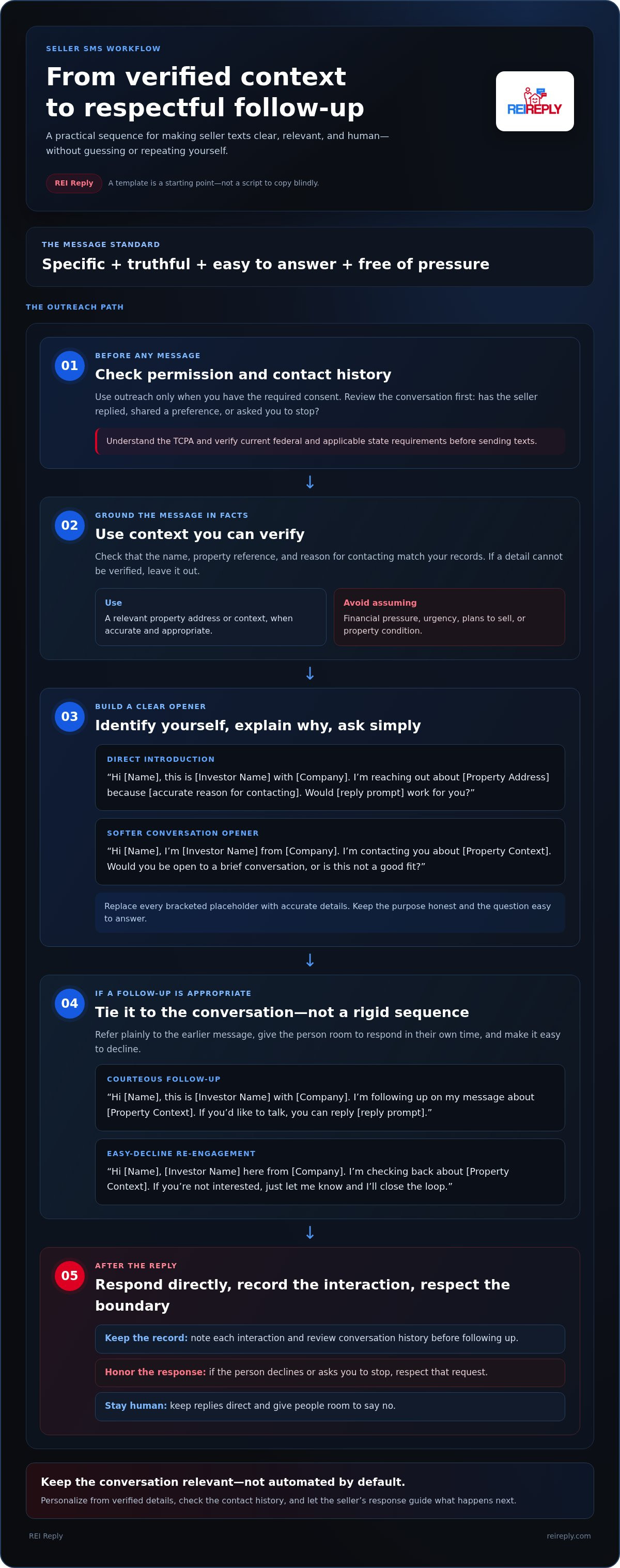
Direct introduction: Use this when you have a relevant, accurate reason to contact the owner and the required permission to send the message.
- Starting point: “Hi [Name], this is [Investor Name] with [Company]. I’m reaching out about [Property Address] because [accurate reason for contacting]. Would [reply prompt] work for you?”
Softer conversation opener: Choose this when you want to give the recipient an easy choice without suggesting they’re ready to sell.
- Starting point: “Hi [Name], I’m [Investor Name] from [Company]. I’m contacting you about [Property Context]. Would you be open to a brief conversation, or is this not a good fit?”
Keep the purpose honest and the question simple. Don’t imply a prior conversation, property condition, or seller motivation unless you can verify it. Before sending, check that the name, property reference, and reason for contact match your records.
Follow-Up and Re-Engagement Text Templates
Courteous follow-up: Use this only when a follow-up is appropriate. Refer to the earlier message plainly, then give the person room to respond in their own time.
- Starting point: “Hi [Name], this is [Investor Name] with [Company]. I’m following up on my message about [Property Context]. If you’d like to talk, you can reply [reply prompt].”
Easy-decline re-engagement: Use this when you have a valid reason to reconnect and it’s appropriate to do so. If the person declines or asks you to stop, respect that request.
- Starting point: “Hi [Name], [Investor Name] here from [Company]. I’m checking back about [Property Context]. If you’re not interested, just let me know and I’ll close the loop.”
Tie follow-ups to the conversation instead of relying on a rigid sequence. Before sending, check whether the seller has replied, shared a preference, or asked you to stop. For broader planning, see this automated lead follow-up system guide. The FCC consumer guidance on texts can help inform responsible messaging practices. To organize seller conversations across channels, explore REI Reply’s investor communication platform.
How to Personalize Seller Texts Without Making Them Feel Scripted
Personalization means using relevant, verified context to make a message specific without guessing about the recipient. A name or property reference can help when it’s accurate and appropriate to the conversation. The best SMS templates for contacting motivated sellers leave room to adjust the wording while keeping the sender, purpose, and question clear.
Adapt the Message to the Seller’s Stated Situation
Separate what the owner has actually shared from what a lead record or property detail might suggest. If motivation is unknown, stick to a neutral inquiry. If the owner has directly mentioned a specific need, acknowledge it in restrained language without applying pressure. Don’t turn age, hardship, or personal circumstances into a sales lever.
| Seller context | Message goal | Personalization cue | Sample approach |
|---|---|---|---|
| General property inquiry | Open a conversation | Verified property reference | “Hi [Name], I’m [Investor Name] with [Company]. I’m reaching out about [Property Address]. Would you be open to a conversation?” |
| Owner has stated they may consider selling | Invite a next step without presuming a decision | The owner’s own words, if relevant and accurately recorded | “Hi [Name], you mentioned you might consider selling [Property Context]. Is that something you’d still be open to discussing?” |
| Owner shared a specific property-related need | Ask whether a conversation would be useful | The need the owner disclosed, stated neutrally | “Hi [Name], you mentioned [Stated Need] regarding [Property Context]. Would you like to discuss whether we could be a fit?” |
| Motivation is unknown or inferred | Check interest without assuming it | Use only confirmed contact and property context | “Hi [Name], I’m [Investor Name] from [Company]. Would you be open to talking about [Property Context], or not at this time?” |
Lead indicators are not the same as a seller’s stated plans. A property signal may help you decide what to ask, but it doesn’t prove urgency or willingness to sell. Keep permission and applicable requirements in view. The FCC rules on text messages offer guidance on unwanted texts.
Choose a Clear Ask and a Natural Voice
One question is enough. Don’t ask the owner to confirm their plans, share a price, and schedule a call all in one text. Identify yourself and your commercial purpose, then choose wording that sounds natural for your business while staying professional.
- More formal: “Hello [Name], I’m [Investor Name] with [Company]. I’m contacting you about [Property Context]. Would you be available to discuss it?”
- More conversational: “Hi [Name], [Investor Name] here from [Company]. I’m reaching out about [Property Context]. Open to a quick conversation?”
Neither style is automatically better. Choose the one that fits your voice, then personalize only the details you can stand behind. If a sentence sounds unnatural when you read it aloud, simplify it before sending.
How to Send Motivated Seller Texts Responsibly and Follow Up Well
Strong templates need a responsible process behind them. Before sending, confirm you have a valid basis to contact the person, understand their communication preferences, and have checked the rules that apply to the message, recipient, and technology you’re using. Federal, state, carrier, and platform requirements can differ and change, so verify current guidance rather than relying on an old checklist. This isn’t a legal guarantee; it’s a practical review to help catch problems before a campaign goes out.
What Should Investors Check Before Sending a Seller SMS?
Review each campaign before launch. Keep the approval process clear and repeatable:
- Confirm permission. Check the documented basis for contacting each person, especially before sending automated promotional texts. A number in a lead record alone doesn’t establish permission.
- Review preferences. Check your contact history for prior requests, communication preferences, or opt-outs. Make sure the record is current.
- Identify the sender. Ensure the message accurately names the investor or business and explains its purpose. Don’t disguise commercial outreach as a personal or unrelated message.
- Check relevance and accuracy. Confirm that property references and other details are verified, and that the text has one clear, appropriate purpose.
- Verify current requirements. Review applicable federal and state rules, carrier policies, and platform requirements with authoritative sources. For example, A2P 10DLC registration and TCPA compliance are separate considerations. Meeting a carrier requirement doesn’t by itself establish legal compliance.
- Test opt-out handling. Confirm that opt-out requests can be recognized, recorded, and used to suppress further marketing texts as required.
Don’t treat a fixed schedule or send window as universally compliant. Requirements can depend on the recipient’s location, message type, and circumstances. Verify current rules for each campaign, including any applicable limits on when marketing messages may be sent.
How Should You Handle Replies, Opt-Outs, and No Response?
When someone asks a question, answer with accurate information and offer one clear next conversational step. If you don’t know an answer, don’t guess. Record the response and relevant context so the next interaction doesn’t contradict what was already said.
Take opt-out requests seriously. Apply them promptly to the appropriate contact records and suppress further marketing texts as required. Silence isn’t an invitation to increase pressure or message volume. Reassess whether another contact is appropriate, permitted, and useful instead of running the same follow-up sequence by default.
The best SMS templates for contacting motivated sellers work best alongside organized contact history and response handling. REI Reply supports seller conversations across texts, calls, email, and social interactions, with contact management and CRM integration. Explore REI Reply’s investor communication platform to organize outreach and follow-up across channels.
Turn Seller SMS Templates into a Consistent Investor Follow-Up Workflow
A template is one step in a seller conversation, not the whole process. Build a simple workflow around it so each message reflects what’s already happened and each reply has a clear next action. This keeps follow-up consistent without making it mechanical.
Move from a Message Template to a Managed Conversation
Use this repeatable sequence for every seller interaction:
- Capture context. Record the contact source, relevant property details, communication preferences, and information the seller has shared.
- Send thoughtfully. Choose a template that fits the context and personalize only details you can verify.
- Record the interaction. Save the message, date, and channel so anyone handling the conversation can see what was sent.
- Respond and set a next action. Log the seller’s answer and note an appropriate next step, such as responding to a question or pausing outreach.
- Review the history. Before contacting the seller again, check prior messages, replies, and preferences for changes or requests.
Conversation history helps prevent avoidable missteps, such as repeating the same opener, asking for information the seller already provided, or sending a follow-up that conflicts with an earlier message. Keep records useful and factual. A short note such as “asked to discuss the property next week” is clearer than a guess about motivation.
Use the channel that fits the seller’s stated preference and the conversation. A text may suit a brief question; a call or email may make more sense if the seller requests it or the topic needs more explanation. Social interactions can also be part of the history when relevant. For related call-handling ideas, read this AI voice agent guide for real estate.
Where REI Reply Fits in an Investor’s Contact Workflow
The best SMS templates for contacting motivated sellers become more useful when they’re part of an organized contact workflow. REI Reply is an AI-powered contact center for real estate investors that supports conversations across texts, calls, email, and social interactions. Contact management, lead qualification, and CRM integration help keep seller context and communication history connected across channels.
AI can support how conversations are organized and handled, but it doesn’t replace accurate records, thoughtful judgment, or appropriate outreach. Explore REI Reply’s investor communication workflow to see how its contact center can bring seller conversations into a more consistent process.
Make Every Seller Conversation More Thoughtful
The best SMS templates for contacting motivated sellers are adaptable starting points, not scripts to send unchanged. Choose wording that fits the seller’s actual context, identify yourself clearly, and make the next step easy to answer. Then manage replies and follow-ups with care, while checking the requirements that apply to your outreach.
Consistency matters, too. Keep accurate conversation records so your next message reflects what the seller has already shared, whether the interaction continues by text, phone, email, or social media. A connected workflow helps organize contact history and handle conversations without relying on memory alone.
REI Reply’s AI-powered contact center supports interactions across calls, texts, emails, and social media, combining AI-powered contact handling with contact management and CRM integration. Explore REI Reply’s AI-powered contact center for real estate investors to build a more organized approach to seller conversations. Start with one relevant message, listen to the response, and let each next step follow from the conversation.
Frequently Asked Questions
What is a good first text to send a motivated seller?
A good first text identifies you, explains why you’re reaching out, and asks one easy question. For example: “Hi [Name], I’m [Investor Name] with [Company]. I’m contacting you about [Property Context]. Would you be open to a brief conversation?” Use only accurate details, and don’t assume the owner wants to sell or is under pressure. Personalize the message, and send it only when your outreach is permitted.
How do you text a homeowner about buying their property?
Be transparent that you’re an investor interested in discussing the property. Keep the message brief, use a verified property reference, and avoid implying you know the owner’s plans. For example: “Hi [Name], I’m [Investor Name] from [Company]. I’m reaching out about [Property Address]. Would you be open to discussing the property?” Make sure your method of contact and message comply with applicable requirements before sending.
How many times should you text a motivated seller?
There isn’t one follow-up count or schedule that fits every seller. Consider the person’s stated preferences, prior replies, conversation context, and applicable rules before deciding whether another message is appropriate. Don’t treat silence as permission to increase message volume. Keep a record of each interaction, reassess whether a follow-up adds value, and stop if the person opts out or asks you not to contact them.
Can real estate investors text homeowners without permission?
Don’t assume you can send a marketing text just because you have someone’s phone number. Automated marketing or promotional texts require prior express written consent; requirements can vary by message type and applicable federal and state rules. Check current authoritative guidance before sending, and document the basis for contacting each person. This information is general guidance, not legal advice.
What should you say when a seller replies that they are not interested?
Acknowledge the answer briefly, thank them for responding, and don’t keep pitching. For example: “Thanks for letting me know, [Name]. I’ll update my records and won’t continue this conversation.” Record their preference and suppress further marketing texts as required. If their message clearly asks you to stop, respect that request promptly. Don’t interpret a polite decline as an invitation to try a different script or channel.
How do you make real estate SMS templates sound personal?
Use a verified detail that belongs in the conversation, such as the property context or something the seller directly shared. Don’t treat a data point as proof of the owner’s motivation. Keep your identity and purpose clear, write in your natural professional voice, and ask one direct question. The best SMS templates for contacting motivated sellers are flexible starting points, not scripts to send unchanged.
Do motivated seller text messages need an opt-out message?
Opt-out handling matters, but the exact requirements for an opt-out notice can depend on applicable laws, carrier rules, and the messaging platform. Check current guidance for your campaign, and make sure requests to stop are recorded and honored as required. Don’t send another marketing text simply to persuade someone who has opted out. Clear records help prevent future outreach from ignoring the person’s preference.


